

The L&D Revolution Is Here: Why AI Adoption Is No Longer Optional
Reading time: 10 minutes | Keywords: AI learning, adaptive learning, workforce transformation, L&D strategy, personalized learning
| KEY TAKEAWAYS |
|
|
|
|
|
The L&D Revolution Is Here: Why AI Adoption Is No Longer Optional
The corporate learning landscape is experiencing its most significant transformation in decades. According to the 2025 LinkedIn Learning Report, 62% of organizations are now expanding their learning and development programs specifically through artificial intelligence implementation. This isn't a marginal trend—it represents a fundamental shift in how enterprises think about talent development, skill building, and competitive workforce readiness.
The numbers tell a compelling story. The 2026 McKinsey Survey on AI in the Workforce revealed that organizations using AI-powered learning solutions see a 45% reduction in time-to-competency for critical roles. Simultaneously, engagement metrics improve dramatically: employees using AI-personalized learning pathways report 34% higher satisfaction scores and demonstrate 38% better course completion rates. These aren't incremental improvements—they're transformative results that directly impact organizational performance.
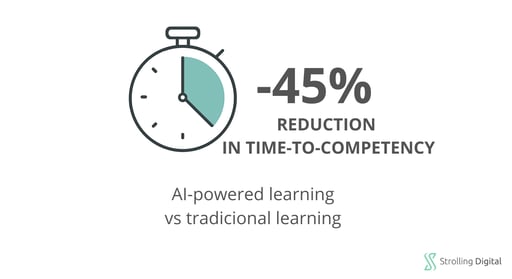
Yet the opportunity remains undercapitalized. While 62% of organizations are expanding L&D through AI, only 18% report having a comprehensive, integrated AI-driven learning strategy. The gap between adoption and optimization represents enormous potential for organizations that move strategically. This is the inflection point—companies that develop sophisticated AI-enabled L&D capabilities now will establish durable competitive advantages that are difficult to replicate.
Understanding the AI-L&D Connection: How Technology Transforms Learning
AI's impact on L&D operates across multiple dimensions simultaneously. At its core, artificial intelligence enables what researchers call "adaptive learning"—systems that analyze individual performance, preferences, and learning styles to deliver customized content in real-time. Unlike traditional training programs that follow a one-size-fits-all approach, AI-powered platforms learn from each employee's interaction patterns and adjust difficulty, pacing, and content delivery accordingly.
3.5X
Organizations using AI-powered learning recommendations see 3.5x higher skill acquisition rates compared to employees relying on self-directed learning, according to Gartner's 2025 L&D Technology Survey
The practical applications span the entire talent development lifecycle. AI handles skills gap analysis at scale, identifying precisely which competencies individual employees need to develop for their current roles and career trajectories. The technology excels at matching employees with relevant micro-learning modules—bite-sized, focused lessons that integrate seamlessly into busy schedules. It provides continuous, personalized feedback without requiring human instructor intervention. And it predicts which employees are at risk of disengagement or attrition, enabling proactive, supportive interventions.
Personalization at Scale: The Core Competitive Advantage
Traditional L&D functions can personalize learning experiences for top talent—executive coaches, customized development plans, targeted mentorship. But scaling this personalization across an organization of thousands of employees has historically been impossible. AI solves this constraint. The technology can simultaneously manage thousands of individualized learning pathways, adjusting recommendations, difficulty levels, and content sequencing for each employee based on real-time performance data and learning behavior.
“ The organizations winning in talent development are those that have figured out how to make personalization scalable. AI doesn't replace the human elements that make learning stick—mentorship, application, community—but it makes delivering truly individualized learning economically feasible for the entire workforce. ”
The Business Case: Quantifying AI-L&D Impact on Organizational Performance
The financial justification for AI-powered L&D is increasingly clear. Companies that implement comprehensive AI-enabled learning systems report measurable improvements across key talent and business metrics. The 2025 Deloitte Human Capital Trends Report found that organizations with mature AI-L&D programs report:
- 28% higher retention rates among employees receiving AI-curated learning pathways, reducing costly turnover and preserving institutional knowledge
- 23% faster time-to-productivity for new hires utilizing AI-guided onboarding and personalized ramp-up learning
- 34% improvement in employee engagement scores, with particularly strong improvements in skill development satisfaction
- 41% better internal mobility rates as employees can more easily identify and pursue development opportunities aligned with their capabilities
These operational improvements directly translate to financial performance. Research by the Josh Bersin Academy found that every dollar spent on advanced learning technology generates approximately $5.50 in measurable business value through reduced attrition, faster productivity, improved performance, and better succession planning outcomes.
$5.50
Return on investment for every dollar spent on advanced AI-powered learning solutions, according to the Josh Bersin Academy's 2025 analysis
The ROI calculation becomes even more compelling when considering the evolving nature of work. The World Economic Forum's 2025 Future of Jobs Report indicates that 60% of the workforce will require significant reskilling by 2030. Organizations without scalable, efficient upskilling mechanisms will struggle to retain relevance. Conversely, companies that use AI to continuously develop and reskill their workforce create a self-reinforcing cycle: more capable employees are more satisfied, less likely to leave, and better equipped to drive innovation and results.
Implementation Priorities: Building Your AI-L&D Strategy
For organizations beginning their AI-L&D journey, strategic implementation matters enormously. Rather than attempting to transform all learning simultaneously, leaders should focus on a sequenced approach that builds momentum and demonstrates clear value early.
Phase 1: Foundation and Assessment
Start by auditing your current learning ecosystem. What skills are most critical to organizational success? Where do capability gaps exist? Which employee populations face the steepest learning curves? Which training programs generate the highest engagement and business impact? This diagnostic work reveals where AI can generate the highest returns. Focus on critical paths: onboarding for customer-facing roles, sales enablement, technical skill development, and leadership pipeline programs typically show the fastest ROI.
Phase 2: Pilot and Validate
Launch pilot programs in high-impact areas with volunteer participant populations. Implement AI-powered skills assessment to identify capability gaps, deploy micro-learning recommendations for addressing identified gaps, and establish feedback loops to measure engagement and learning outcomes. Document results rigorously. The goal is generating compelling proof-of-concept that demonstrates tangible value—reduced time-to-competency, improved engagement, measurable skill improvement—that justifies broader investment.
Phase 3: Integration and Scaling
Once pilot programs demonstrate success, begin systematic rollout across the organization. This requires addressing infrastructure questions: Which learning management systems will you leverage? How will you integrate AI-powered recommendations into the daily workflow? What data governance and privacy protocols will guide your implementation? How will you ensure managers understand and support AI-enabled learning? These orchestration questions matter as much as technology selection.
Avoiding Common Pitfalls: What Organizations Get Wrong
As more organizations accelerate AI-L&D adoption, predictable challenges emerge. Understanding these common pitfalls helps leaders navigate implementation more effectively.
- Overestimating AI's capacity to replace human connection: AI excels at content delivery and personalization, but learning is fundamentally social. The most effective AI-L&D implementations combine algorithmic personalization with human mentorship, peer learning, and managerial coaching.
- Insufficient change management and stakeholder engagement: L&D professionals may perceive AI as a threat to their roles. Managers may resist data-driven insights about their team's learning needs. Employees may distrust algorithms curating their development. Addressing these perspectives through transparent communication, involvement in implementation, and clear articulation of how AI enhances rather than replaces human expertise is essential.
- Inadequate attention to data quality and bias: AI systems learn from historical training data. If that data reflects past biases—in who received high-quality learning, whose development was prioritized, whose skills were recognized—the algorithms will amplify those biases. Regular audits for fairness, diverse training data, and explicit programming to counteract historical inequities are necessary.
- Treating L&D as a technology problem rather than a business strategy issue: The best AI-L&D outcomes emerge when the learning strategy is tightly aligned with business strategy. What skills do we need to execute our strategy? How will we develop competitive advantage through workforce capabilities? How does learning connect to succession planning, talent retention, and innovation? These strategic questions should precede technology selection.
The Future of Work Demands the Future of Learning
The convergence of technological change, evolving workforce expectations, and competitive pressure creates an unprecedented imperative for AI-powered learning. The organizations leading their industries aren't just implementing AI-L&D as a cost-reduction measure. They're leveraging the technology as a strategic differentiator—a capability that enables them to attract top talent, develop capabilities faster than competitors, and maintain relevance in rapidly changing markets.
60%
Percentage of the global workforce requiring significant reskilling by 2030 according to the World Economic Forum's Future of Jobs Report
This reskilling imperative will define organizational competitiveness over the next five years. Companies that figure out how to help their entire workforce continuously learn and adapt will thrive. Those that maintain traditional, static training approaches will find themselves unable to compete for talent or execute their strategies effectively. The good news: the technology, approaches, and implementation roadmaps all exist today. The companies winning tomorrow are starting today.
Moving from Theory to Practice
At Strolling Digital, we've seen firsthand how organizations that move strategically on AI-enabled talent development transform their competitive positioning. The most successful clients begin with clear-eyed assessment of their current state, align their learning strategy explicitly with business strategy, invest in change management and stakeholder engagement, and measure results obsessively. They understand that AI isn't magic—it's a powerful tool that amplifies intentional strategy. And they recognize that the real competitive advantage comes not from the technology itself, but from how effectively they use that technology to develop their people.
Conclusion
The acceleration of AI-driven learning marks a historic turning point for workforce development. Organizations that embrace adaptive learning systems, data‑driven skills intelligence, and scalable personalization will build resilient, future‑ready teams capable of navigating constant technological and market shifts. Those that hesitate risk falling behind in talent competitiveness, innovation capacity, and strategic execution. The path forward is clear: AI‑enabled L&D is no longer an experimental initiative—it is a foundational capability for organizations determined to grow, transform, and lead in the digital era.
Ready to transform your learning strategy?
If you want to implement AI adoption strategies, digital talent development, or organizational transformation, get in touch with Strolling Digital. Let’s talk.
References
- LinkedIn Learning Report 2025
- McKinsey Survey on AI in the Workforce 2026
- Gartner L&D Technology Survey 2025
- Deloitte Human Capital Trends Report 2025
- Josh Bersin Academy 2025
- World Economic Forum Future of Jobs Report 2025
Comments