Cybersecurity
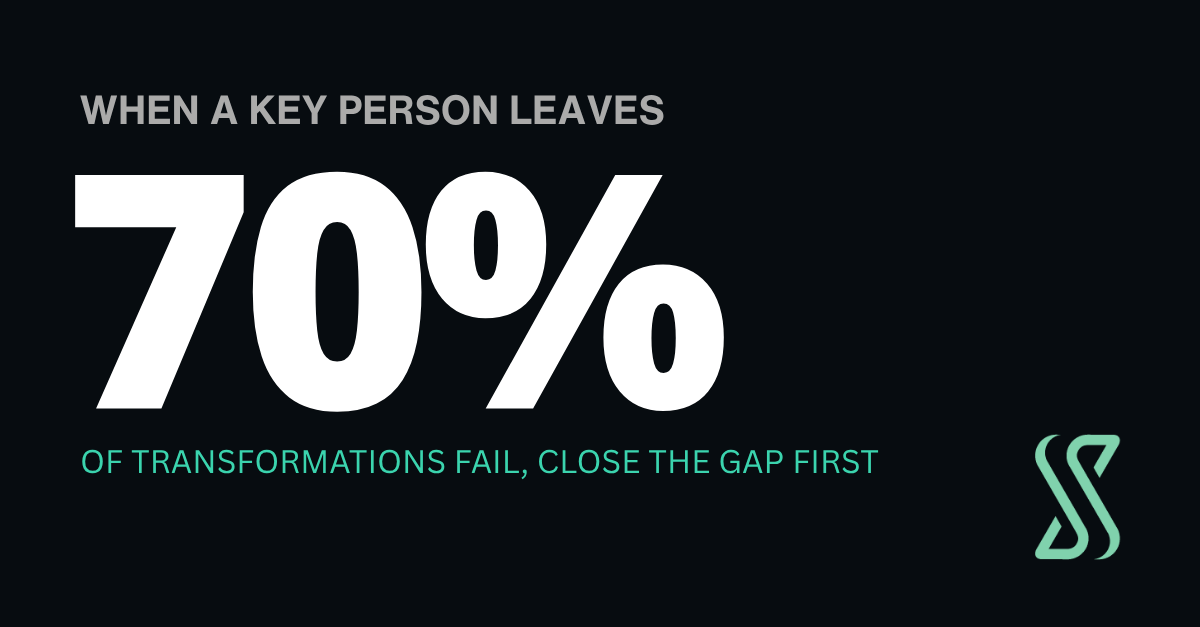


70% of transformations fail to hit their goals, and losing the one person who understood the project is often where that failure starts.
A capability gap opens the moment a senior project resource leaves, and what happens in the following weeks decides whether the project stalls or keeps moving. For CEOs, COOs and transformation directors running multi-year initiatives in retail, FMCG or healthcare, that gap is rarely about talent available in the market. It is about who still has access to what the departing person knew.
Reading time: 9 minutes | Keywords: capability gap, tactical staffing, interim management
| Key Takeaways |
75% of client organizations say interim professionals fill critical skill gaps their internal teams could not close alone (Heidrick & Struggles, 2026).
|
A transformation project rarely stalls because the team stopped working. It stalls because the one person who held the vendor relationships, the process history or the sequencing logic for a multi-market rollout is no longer in the room. In a multi-country retail transformation, a cross-border FMCG merger or a healthcare digitalization program, that knowledge is often concentrated in two or three people: a store operations lead, a logistics integration manager, a commercial operations lead. When one of them leaves mid-project, for a better offer, a reorganization, or simple misalignment with where the project is heading, the rest of the team does not lose willingness. They lose access.
This is where Q4 becomes relevant. As budgets close for the year and planning for 2026 begins, boards and executive committees are deciding which stalled initiatives get funded again and which get quietly shelved. A capability gap left unaddressed through Q4 does not disappear over the holidays. It becomes next year's line item for a project that already missed its original deadline.
"Nobody is truly indispensable. But the project still pays for the gap in weeks of delay, not in principle." — Natalia Perrone, Founder, Strolling Digital.
According to McKinsey & Company (2022), 70% of large-scale transformations fail to meet their intended outcomes, and losing momentum after a leadership or sponsor change is one of the most cited reasons why. The question for a director or CEO facing this today is not whether to act. It is whether to wait for a permanent hire that may take months to onboard, or bring in a tactical profile that can close the specific gap now.
People who hold critical project information rarely leave because the project is failing. They leave because they are uncomfortable with the direction, because of budget cuts elsewhere in the organization, or because their priorities shifted away from a project they were never fully aligned with. None of that is unusual in transformation work. What is unusual is how often companies are caught without a plan for it.
The real cost is not the empty seat on the org chart. It is the decision trail that walked out the door with that person: why a vendor was chosen over another, why a rollout sequence changed in month four, why a specific exception was made for one site but not another. Once a project runs into that kind of trouble, full recovery is far from guaranteed. PMI's own review of troubled-project recoveries puts full-scope success at roughly one in three engagements once a project is already off track (PMI, 2007).
This is why documentation during the project, not after a departure, is the actual insurance policy. Years of tacit knowledge cannot be reconstructed from meeting notes alone, but a clear record of decisions and the reasoning behind them lets an external profile step in and read the situation in days rather than months. Nobody needs to hold the entire history in their head. They need to understand the big picture well enough to keep moving while the gap gets filled properly.
Three mistakes show up again and again when a company loses a sponsor or a key stakeholder mid-project.
The fix starts with a short, honest assessment: what capability is actually missing. Technical execution, relationship continuity with a vendor, or decision authority the team no longer has. A tactical staffing profile matched to that specific gap, paired with a short change management plan for what gets communicated and to whom, closes it without adding a permanent headcount decision to an already disrupted quarter.
"The person who resists the loudest is usually the one you most need in the room. Bring them in early and they become your best advocate." — Natalia Perrone, Founder, Strolling Digital.
Tactical staffing used to be treated as emergency coverage: bring someone in, stabilize the project, let them go. That is changing. 42% of interim engagements now run longer than six months, up from 27% in 2021, and for experienced independent professionals, 55% of projects now run twelve months or more (Heidrick & Struggles, 2026). For project-driven organizations in retail, FMCG and healthcare, where teams already rotate across markets, functions and initiatives by design, this is not a workaround. It is closer to how the work actually gets done.
Before the next capability gap opens, a leadership committee should be able to answer three uncomfortable questions without the current sponsor in the room:
Strolling Digital's role in this is deliberately narrow: identify where the real gap sits, bring in the right tactical profile through a business analyst assessment, and build the short change management plan that gets the rest of the team communicating on the same page again. The goal is not to replace the person who left. It is to remove the noise so the project can move without them.
A capability gap is not a talent shortage and it is not a budgeting failure. It is a continuity design failure, and it shows up at the worst possible time, mid-project, mid-quarter, mid-decision. The companies that recover fastest are not the ones with the deepest bench. They are the ones that treat documentation as part of the project plan from day one, and that know exactly which gap they need filled before they go looking for who fills it.
Q4 is when this decision gets made or postponed. Postponing it does not make the gap smaller. It moves the cost into next year's budget, alongside a project that is now further behind than it needs to be.
If a key person left your project and progress stalled since, what is actually missing: capacity, capability, or the decision trail they took with them?
Find out with a short diagnostic session with Strolling Digital. Let's talk.
A capability gap is the point where a project cannot move forward because the specific knowledge, relationships or decision authority needed to progress are no longer available inside the team. It usually appears when a senior stakeholder or subject matter expert leaves mid-project, and it is a gap in access to information, not a gap in effort from the remaining team.
Bring in an interim or tactical profile when the gap is specific and time-bound, such as a departed sponsor, a stalled workstream, or a decision that needs an outside, objective view. A permanent hire takes months to source and onboard, while a tactical staffing profile can be matched to the exact skill missing and start closing the gap within weeks.
The project typically loses access to undocumented decisions, vendor context and informal agreements the sponsor held, even if the remaining team is fully capable and motivated. Without a plan, this often shows up weeks later as delays, rework or disagreements over choices that were already settled earlier in the project.
Start with a short assessment of what capability is actually missing, then bring the person in against that specific gap rather than a general title. Share information gradually and deliberately, involve the team's most skeptical voice early rather than last, and give the new profile clear authority for the piece of the project they were brought in to own.
They overlap but are not identical. Tactical staffing typically fills a specific, well-defined skill or capacity gap for a defined period, while interim management usually involves stepping into a leadership or decision-making role on a temporary basis. Both are used to keep a project moving without committing to a permanent hire before the organization is ready.
Duration has grown in recent years. 42% of interim engagements now run longer than six months, up from 27% in 2021, and among experienced independent professionals, more than half now run twelve months or longer (Heidrick & Struggles, 2026). Short, crisis-only engagements are no longer the default.
Ask whether the team could answer three questions without the current sponsor in the room: who could step in if this person left today, which two or three processes cannot afford a gap in ownership, and whether the organization is genuinely prepared to keep moving without that person. If the answers are unclear, the gap already exists, it just has not caused a delay yet.