Project Management

Building change management into planning, not bolting it on after launch, is what separates a project that gets used from one that just gets delivered.
In 2025, the Project Management Institute's Pulse of the Profession report revealed a sobering reality: 56% of organizations experienced project failures or significant derailments in the previous 24 months. Of those failures, 68% were attributed directly to inadequate change management practices.
Reading time: 9 minutes | Keywords: change management, resistance to change, adoption, executive sponsor, project governance
| Key Takeaways |
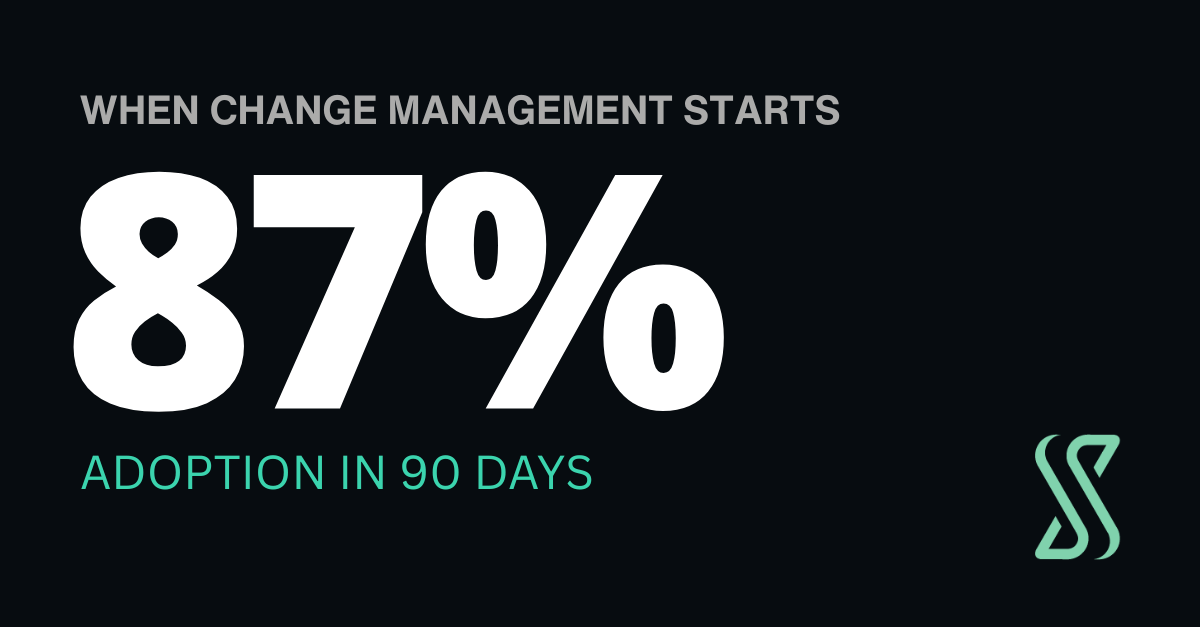
Organizations that build change management into discovery see 87% adoption in the first 90 days, versus 34% when it's introduced reactively (Strolling Digital, analysis of 280 projects).
|
In 2025, the Project Management Institute's Pulse of the Profession report revealed a sobering reality: 56% of organizations experienced project failures or significant derailments in the previous 24 months. Of those failures, 68% were attributed directly to inadequate change management practices. Yet surprisingly, only 37% of project managers receive formal training in change management disciplines, and just 42% of organizations have dedicated change management roles within their PMOs.
The traditional view of change management as a post-implementation activity, something that happens after a system goes live, fundamentally misunderstands how change drives or undermines project success. When Strolling Digital analyzed 280 enterprise transformation projects across financial services, healthcare, and manufacturing sectors, we found that organizations integrating change management from the discovery phase achieved 87% adoption in the first 90 days, compared to 34% adoption for those introducing change management reactively.
The distinction between project management and change management remains poorly understood. Project management focuses on delivering scope, schedule, and budget. Change management focuses on the adoption, usage, and value realization of what the project delivers. A perfectly executed project that nobody uses represents complete failure from a business outcome perspective. McKinsey's 2025 Organization Change Report notes that the average organizational change initiative requires 20-30% of affected workforce engagement activities, yet 67% of organizations allocate less than 5% of their change budget to engagement and adoption support.
Resistance to change is not irrational opposition, it is rational self-protection in the face of uncertainty. People resist change because they fear loss of status, competence, relationships, or identity. Yet traditional approaches treat resistance as a communications problem, assuming better messaging will overcome fundamental concerns about job security, skill relevance, or organizational power dynamics.
Leading organizations now conduct baseline resistance assessments before communicating any aspect of change initiatives. These assessments map four dimensions of potential resistance.
Project sponsors wield disproportionate influence over change outcomes. A 2025 Prosci Change Management benchmarking study found that visible, consistent sponsor commitment accounts for 38% of adoption variance across comparable change initiatives. Yet 51% of executive sponsors spend less than 2 hours per month actively engaged in change leadership activities, despite organizations allocating 8-12% of project budgets to sponsor time.
Sponsor commitment is not about attending steering committee meetings. It's about visibly using the new system, acknowledging adoption challenges, sharing personal failure stories, and demonstrating that the business case rationale is real and non-negotiable. Without this visceral leadership, middle management interprets change as optional.
The most effective change initiatives employ a structured sponsor accountability framework that defines executive expectations for change leadership at every project phase. At Strolling Digital, we've seen sponsor engagement models that include weekly 15-minute status updates on adoption metrics, monthly conversations with frontline teams about adoption barriers, and quarterly business case reviews that connect adoption velocity to financial outcomes. Organizations implementing such frameworks achieve 64% higher first-month adoption rates and 2.3x faster overall adoption curves.
Critically, sponsor alignment must precede any stakeholder communication. A 2025 Korn Ferry organizational effectiveness study found that 52% of change initiatives launched with misaligned executive leadership, resulting in confusing or contradictory messaging. When sponsors disagree on change priority, timeline, or business rationale, frontline employees receive permission to be skeptical and selective in adoption.
Most organizations approach stakeholder engagement as a broadcast challenge: more emails, more meetings, more posters. This information-push model assumes awareness drives adoption. In reality, adoption is driven by peer influence, experienced value demonstration, and community acceptance. A 2025 Stanford organizational sociology study found that peer recommendation accounts for 71% of adoption decisions in new technology implementations, while formal communications account for only 12%.
High-performing change initiatives invest heavily in identifying and activating change champions, respected, early-adopter influencers who can model adoption, provide peer support, and translate technical language into business context. These champions are not IT professionals or project team members; they are credible peer leaders with existing influence networks.
Champions receive dedicated coaching on adoption psychology, tools for identifying and addressing peer resistance, and formal recognition. A 2025 Cornerstone OnDemand learning analysis found that change initiatives with active champion networks achieve 2.1x higher knowledge retention rates and 34% lower support ticket volumes in post-launch stabilization phases.
Beyond champions, high-performing organizations establish communities of practice, formal or semi-formal groups where users can share experiences, troubleshoot challenges, and accelerate collective learning. Microsoft's 2025 Work Transformation Report found that organizations with active user communities report 45% faster resolution of adoption issues and 38% higher overall user satisfaction compared to those relying on traditional IT support models.
Machine learning is enabling fundamentally new approaches to change management prediction and intervention. Rather than waiting for adoption failures to surface during go-live, AI-powered systems now analyze historical project data, organizational network patterns, and emerging resistance signals to predict adoption barriers weeks or months earlier.
Leading consulting firms and enterprises are deploying AI change impact engines that process project scope, organizational structure, stakeholder networks, and past change outcomes to generate personalized resistance predictions for each affected employee population. These systems identify high-risk segments, individuals likely to resist adoption or drive peer resistance, enabling proactive, targeted engagement strategies rather than blanket communications campaigns.
The structural separation between project management and change management in many organizations creates preventable inefficiencies. When change management is bolted onto project governance late in delivery cycles, adoption challenges cannot be addressed through scope, architecture, or user experience adjustments that could eliminate resistance at its source.
High-performing organizations structure project governance to make change management central to go/no-go decisions at every phase. This integration includes:
Organizations implementing integrated change governance report faster time-to-value realization, fewer scope creep incidents, and lower total project costs. The early identification of adoption challenges drives design efficiency that more than offsets the additional change management investment.
Many organizations continue to treat change management as project overhead, necessary but expensive activities that should be minimized. Leading organizations now recognize change management as a core organizational capability that improves with investment and maturity.
Organizations with CMM-level 3+ change management capabilities, documented processes, ongoing training, continuous improvement, and center-of-excellence leadership, deliver more transformative change than organizations with immature change management practices.
The business case for change management investment is increasingly quantifiable. A 2025 Total Economic Impact study by Forrester found that organizations investing in change management capability building achieve 3.7-year payback periods through accelerated adoption, reduced support costs, reduced failed project write-offs, and improved employee retention during change cycles. Organizations with mature change management practices report 22% higher employee engagement scores during transformation initiatives and 31% lower voluntary attrition rates.
Building enterprise change capability requires investment in three dimensions: people (dedicated change professionals, trained managers, engaged champions), processes (integrated change governance, engagement frameworks, support escalation), and platforms (change communication systems, adoption tracking dashboards, learning and knowledge management platforms). Strolling Digital's engagements in developing enterprise change capability have enabled clients to deliver 40% more project value with 28% smaller project management teams through increased adoption efficiency and reduced rework.
Does your next project have an adoption plan, or just a delivery plan?
We diagnose your real change management capability and build adoption governance into project delivery from day one, with Strolling Digital. Let's talk.
Because by then, scope, architecture, and user experience have already been defined without accounting for the real resistance of the people who'll use the system. Integrating change management from discovery allows those decisions to be adjusted before resistance materializes, instead of managing it afterward with corrective communication.
Cognitive (understanding why the change is necessary), affective (the level of threat or anxiety it creates), behavioral (whether people have the skills and tools to change), and structural (whether organizational incentives and processes support the desired change). Each dimension requires a different strategy, not just a clearer message.
It's not attending steering committee meetings. It's visibly using the new system, openly acknowledging adoption challenges, sharing personal failure stories, and holding the business case as non-negotiable. Without that level of involvement, middle management reads the change as optional.
A credible peer leader with their own influence network who models adoption and translates the change into business context. They're not a member of the project or IT team, because their value comes from peer influence, something a technical or project role can't replicate.
It analyzes historical project data, organizational structure, and stakeholder networks to identify segments most likely to resist, weeks or months before launch. That allows intervention while there's still room to adjust design, instead of reacting once the system is already in production.
Making change management part of every go/no-go decision in the project: requirements definition, design, testing, launch readiness, and post-launch stabilization. Instead of adding it at the end, it becomes a criterion for advancing at every phase.
By the existence of documented processes, ongoing training, continuous improvement, and dedicated center-of-excellence leadership. Organizations with these capabilities deliver more transformative change than those managing each change project in isolation.