Talent Management
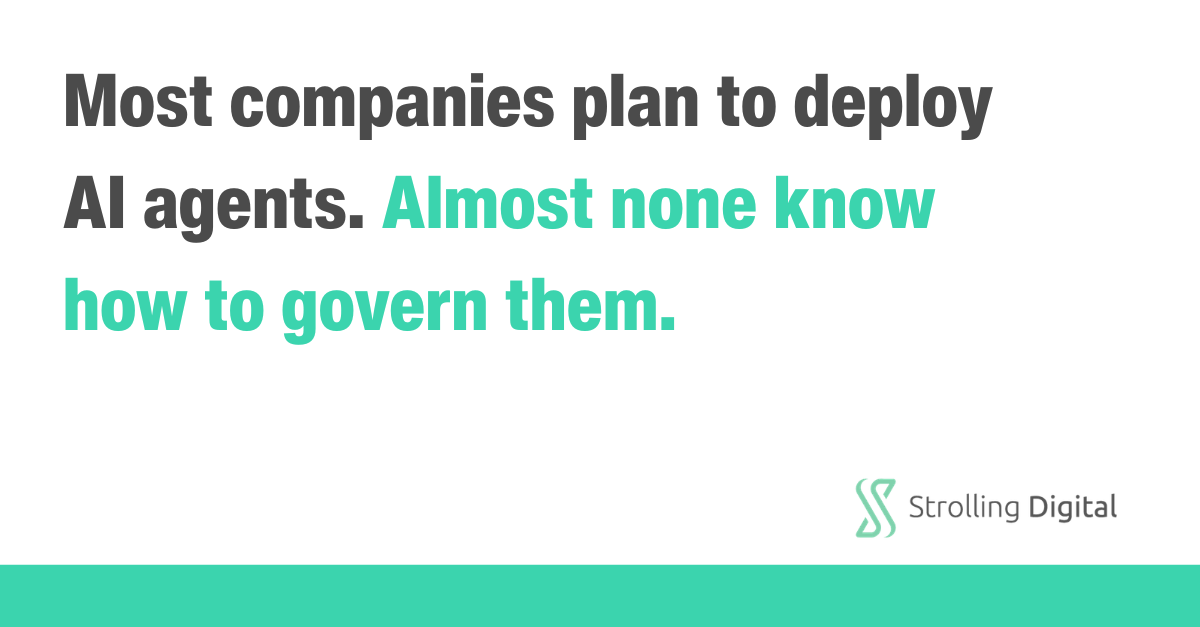

Why AI governance is now an operational risk problem, not a compliance checkbox
Only 30% of organizations have adequate AI governance frameworks in place, leaving the rest exposed to the same kind of undetected failure cybersecurity teams have spent a decade guarding against. Here's what closes that gap before regulators, customers, or an autonomous agent force the issue.
Reading time: 5 minutes | Keywords: AI governance, AI agent governance, EU AI Act, responsible AI, operational risk
| Key Takeaways |
Only 30% of organizations have adequate AI governance frameworks, leaving 70% exposed to real operational risk.
|
Most organizations already run a governance function for operational risk: security incident response, access controls, audit trails, vendor risk. AI systems are being deployed into the same operations, at the same scale, often with fewer controls. That gap is the real story behind the numbers: 70% of enterprises are actively deploying AI, but only 30% have established governance frameworks adequate to manage the risk.
This isn't an abstract ethics problem. It behaves like an unmanaged security risk: decisions nobody can fully explain, no owner accountable when something goes wrong, no tested response plan for when it does. AI systems trained on biased historical data perpetuate discrimination without anyone catching it. Algorithmic decisions on customer service, hiring, and lending happen in black boxes. Compliance becomes reactive. Trust erodes in public, the same way it does after a breach.
The regulatory clock is already running. The EU AI Act took effect in 2026, setting hard requirements for high-risk AI systems: bias testing, transparency documentation, human oversight. Non-compliant organizations face fines reaching up to 7% of global annual turnover (or €35 million, whichever is higher) for the most severe violations, on top of reputational damage that outlasts the fine.
The EU AI Act sorts AI systems by risk level and sets governance requirements accordingly. High-risk systems, those touching fundamental rights, employment decisions, or essential services, must meet standards that look familiar to any security or risk function: documented impact assessments, bias monitoring, training data documentation, human oversight mechanisms.
For organizations operating in or serving European markets, this isn't optional. The framework requires documented decision-making processes, audit trails, and evidence of fairness testing. Non-compliant systems can be pulled from operation outright, and breaches of high-risk system requirements carry fines up to 3% of global annual turnover.
AI systems reflect the data they're trained on. When that data carries historical bias, in hiring, in lending, the system doesn't correct it, it scales it. A hiring algorithm trained on historical patterns can systematically screen out qualified candidates from underrepresented groups. A lending model can deny credit along demographic lines nobody intended to encode.
Managing that requires the same discipline security teams already apply to other operational risks: continuous monitoring, not a one-time check. Organizations need baseline fairness metrics before deployment, ongoing monitoring across demographic groups, and a human review layer for high-impact decisions. Treat it as a checkbox and the exposure doesn't go away, it just goes undetected until a customer, a regulator, or a journalist finds it first.
"AI governance is not a compliance checkbox, it's the control layer that makes AI deployment survivable at scale."
AI agents, autonomous systems that act with minimal human intervention, are where this risk concentrates. A traditional model recommends; a human approves. An agent decides and acts. That shift moves AI from a decision-support risk to an operational execution risk, the same category as an unmonitored system with production access.
Only 1 in 5 organizations has a mature model for governing autonomous agents (Deloitte, 2026). 85% of organizations plan to customize and deploy agents into business operations (Deloitte, 2026). That gap is the equivalent of expanding system access faster than you can expand monitoring.
Deploy agents without this in place and the failure modes are operational, not theoretical: agents making harmful decisions that touch customers or employees, bias compounding undetected, and no ability to reconstruct why an agent did what it did when a regulator or a customer asks.
A responsible AI framework covers four areas. Treat any one of them as optional and the others don't hold.
Decide, at the business level, what outcomes are acceptable, which stakeholder groups need protection, and which decisions should never run fully automated. This is a governance decision, not a technical one, made before deployment, not after an incident.
Anyone affected by an AI decision, a customer, an employee, a regulator, is entitled to know why. "The algorithm decided" is not an answer a regulator, or a court, will accept.
Data science teams build the models. Business owners stay accountable for what the models do. That ownership needs to be explicit, with a governance process for validation, monitoring, and intervention when something drifts.
Treat AI risk the way you'd treat any operational risk: bias, model drift, adversarial manipulation, regulatory exposure. Build monitoring to catch it early and an incident response process for when it fails anyway, because it will.
Phase 1: Assessment and planning (weeks 1-6). Audit existing AI systems, identify governance gaps, assign ownership, map regulatory requirements by industry and region.
Phase 2: Framework development (weeks 7-16). Set AI ethics principles aligned with the organization's actual values, not generic ones. Establish bias testing and fairness monitoring. Build impact assessment templates.
Phase 3: Technical implementation (weeks 17-26). Deploy bias monitoring and explainability tooling. Implement model validation and ongoing performance monitoring. Establish escalation and incident response procedures, the same muscle used for security incidents.
Phase 4: Operationalization (weeks 27+). Build governance into the AI development process itself, not as a gate at the end. Set review cycles. Build internal capability through training and hiring.
Organizations that treat AI governance purely as risk management miss the operational upside: governance is what lets you deploy faster, with confidence.
Customer trust moves faster with transparency. Customers increasingly choose organizations that can explain how they use AI responsibly. Regulatory approval moves faster with documentation already in place, which shortens time-to-market. Talent decisions get easier, as technology professionals increasingly choose employers with a real governance function, not just a policy document. And scale becomes possible: with governance in place, organizations extend AI into more of the operation with confidence, instead of stalling at pilot stage.
The organizations winning aren't the ones cutting corners on governance, they're the ones where governance is what lets them move faster, with fewer surprises.
Is your AI governance keeping pace with how much AI you've already deployed?
Closing that gap is operational work, not paperwork, and it's where Strolling Digital comes in. Let's talk.
High-risk systems must undergo documented impact assessments, ongoing bias monitoring, training data documentation, and maintain human oversight mechanisms. Organizations must also keep audit trails and evidence of fairness testing.
Penalties are tiered: up to 7% of global annual turnover (or €35 million) for prohibited practices, up to 3% (or €15 million) for breaches of high-risk system requirements, and up to 1% (or €7.5 million) for supplying incorrect information.
Traditional AI models recommend and a human approves the decision. Agents act autonomously with minimal human intervention, which moves the risk from decision-support to operational execution, requiring more oversight, not less, as autonomy increases.
Ethics and fairness, transparency and explainability, accountability and governance, and risk management. Skipping any one of the four weakens the other three.
Start with a phased rollout: audit existing AI systems and assign ownership, build ethics principles and bias testing procedures, deploy monitoring and explainability tooling, then operationalize governance into the AI development process itself.