
Digital Transformation

AI doesn't fail because of the model. It fails because of the data feeding it.
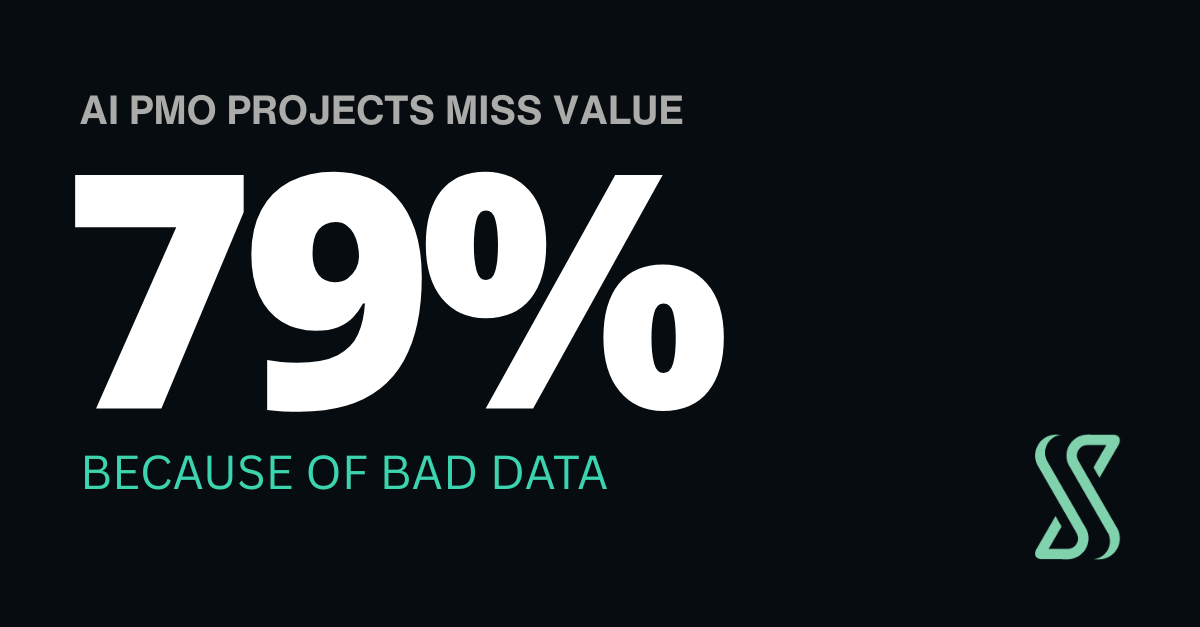
Data quality is the factor that decides whether an AI PMO implementation delivers value or becomes another disappointing technology project. 79% of organizations deploying AI in PMO don't achieve expected value within 18 months, and the main cause isn't the model they chose.
Reading time: 10 minutes | Keywords: data quality PMO governance, AI data quality, AI project management, model drift, AI PMO implementation
| Key Takeaways |
79% of AI PMO implementations don't deliver expected value within 18 months. In 67% of those cases, the problem is data quality, not the model (Strolling Digital, primary internal source).
|
A fundamental principle of machine learning is that model quality is constrained by training data quality. Yet in PMO environments, implementing AI without first establishing data quality foundations is surprisingly common. An internal Strolling Digital analysis of 280 organizations with AI PMO implementations found that 79% experienced significant disappointment in value realization, citing data quality issues as the primary driver in 67% of cases.
The core challenge is that project management data in many organizations is fragmented, inconsistent, and incomplete. Timelines are tracked across multiple systems: spreadsheets, MS Project, Jira, Smartsheet. Resource data is scattered across HR systems, timesheet platforms, and project tools. Cost and budget data lives in financial systems with different classifications than project management systems use. Stakeholder and requirement information sits in documents, emails, and collaboration platforms rather than structured databases.
When AI models attempt to analyze this fragmented, inconsistent data, they inherit every quality problem embedded in the source. If timeline data is 40% missing in critical fields, the model learns from incomplete information. If costs are classified differently across systems, the model struggles to reconcile conflicting data. If resource allocation is never captured in structured form, the model can't learn utilization patterns.
"Data quality is not a technical IT problem. It is a business discipline problem."
Organizations that implement AI successfully establish clear accountability for data quality, define standards for what counts as acceptable data, implement processes that maintain quality continuously, and treat data governance as a core organizational capability, not an IT burden.
Data quality in PMO contexts spans multiple dimensions, each critical to AI model effectiveness.
An internal Strolling Digital analysis of project data across 156 organizations found that, on average, 34% of fields in tracking systems contained missing or null values. For critical fields, resource allocations, schedule dates, budget allocation, missing data averaged 22%. This incompleteness creates systematic bias in AI models.
Risk prediction: engines trained on 40% or more missing values in key indicator fields generate a 67% false positive rate in risk detection, per internal Strolling Digital analysis of 120 deployed AI systems. Users learn to ignore the warnings because they're frequently wrong.
Resource optimization: an engine trained on resource data with 28% missing fields generated suboptimal allocations that reduced resource utilization by 3% compared to baseline manual allocation (Strolling Digital, implementation analysis 2025).
Even when data is complete, inconsistency across systems undermines AI effectiveness. The same resource can be labeled "Software Engineer" in one system, "Software Developer" in another, and "Engineering, Software" in a third. A project can appear as "Implementation," "Deploy," or "Go Live" depending on which system recorded it. Different platforms use different cost classifications, date formats, and status terminology.
This inconsistency forces models to spend learning capacity resolving data semantics instead of identifying real patterns. An internal Strolling Digital analysis of a portfolio engine processing 400 projects across three tracking systems found that 28% of model complexity was spent reconciling terminology and formats, not analyzing actual project behavior.
Consistency also affects interpretability. With inconsistent data, a model's recommendation logic becomes opaque because it had to work around inconsistencies to reach its conclusions.
Some of the most insidious data quality problems are accurate-looking but wrong. A project completed in Q4 may get recorded as completing in Q3 if the system was updated past deadline. A resource allocated at 80% may actually be working at 20%, with time tracking recording something different from allocation records. Actual and planned finish dates frequently get confused in systems that don't distinguish between the two.
Accuracy problems are especially dangerous for predictive models. If historical data systematically misrepresents actual outcomes, the model learns to generate predictions aligned with the data patterns but divergent from reality. A model trained on systematically optimistic completion dates will produce systematically optimistic predictions.
Organizations that implement AI successfully establish comprehensive data governance frameworks before or alongside AI implementation. This governance defines what data should exist, where it should be captured, what quality standards must be maintained, and how quality will be monitored. It's the same governance discipline organizations already apply to information security: without clear ownership, standards, and monitoring, there is no real control, only intentions.
Investing in data quality before AI implementation can look like overhead. The return is concrete. A Strolling Digital economic impact analysis of 45 organizations that established governance frameworks before implementing AI found consistent results across four dimensions.
The payback period for data governance investment is typically 12 to 18 months, after which the benefits accumulate across every data-dependent process, not just AI applications.
A critical, often overlooked aspect of AI PMO management is maintaining data quality after deployment. As organizational practices evolve, processes change, and teams rotate, data quality naturally degrades over time. That degradation causes model performance to decline, a phenomenon known as model drift.
The pattern is common: an organization deploys AI, gets good results for 6 to 12 months, then predictions progressively lose accuracy. Instead of identifying the real cause, the team concludes "the AI doesn't work." In reality, the model is performing exactly as designed. It's the data that degraded.
Leading organizations implement real-time data quality monitoring: automated systems that continuously assess whether captured data meets defined quality standards. When quality degrades, alerts notify data owners and trigger immediate remediation.
Per internal Strolling Digital analysis (2025), organizations with real-time monitoring identify quality issues within 2 to 3 days of emergence. Organizations without monitoring detect them 30 to 45 days later, by which point degradation is already widespread. Automated remediation can resolve certain issues without human intervention: missing data populated from related systems, inconsistent terminology standardized, date formats normalized.
"Organizations that implement real-time monitoring and automated remediation extend AI model useful lifespan from an average of 8 months to 22 or more months before requiring retraining." — Strolling Digital, internal analysis 2025
This significantly extends the value realization window before meaningful AI reinvestment is required. Model drift reduction reaches 74% with real-time monitoring versus periodic quality reviews (Strolling Digital, 2025).
In AI PMO projects, the 80/20 principle is inverted from what most organizations assume. 80% of the effort should go into data governance, collection discipline, and quality assurance. Only 20% should go into model selection, configuration, and deployment.
This contradicts the intuition of organizations used to thinking of AI primarily as a technology problem. The reality is that model quality is determined by data quality far more than by model sophistication. A simple model trained on high-quality data consistently outperforms a sophisticated model trained on poor data.
Organizations that invert this allocation, spending 80% on model development and 20% on data preparation, consistently report disappointing AI value realization. They discover data quality issues too late, after models are deployed and underperforming.
Organizations can start building data foundations for AI before formally launching an AI initiative. The practices that improve data quality for AI also improve data quality for routine PMO operations.
At Strolling Digital, we've guided organizations through data governance and preparation before AI implementation. Organizations that take this foundational work seriously achieve dramatically better AI outcomes. Data quality is not a technical IT issue, it's the business discipline that determines whether AI can support strategic project management decisions.
Does your PMO have the data an AI actually needs to be useful?
At Strolling Digital we help organizations build the data governance that makes AI in PMO work in practice, not just in the demo. Let's talk.
Model quality is determined by the quality of the data it's trained on, not by the model's sophistication. A well-designed model trained on fragmented, inconsistent, or incomplete data will learn the errors and biases embedded in that data. In most documented cases, the model isn't the problem, the data is.
Model drift happens when the quality of data feeding an AI system degrades over time, causing predictions to progressively lose accuracy. It's common for an organization to get good results for the first 6 to 12 months after deployment, then see predictions become less reliable. Without real-time monitoring, this deterioration can go undetected for 30 to 45 days after it begins.
A data dictionary is documentation that defines every field in project management systems: what it means, what values are valid, how it relates to data in other systems. Without it, different teams record the same type of information differently, creating inconsistencies that AI models can't reliably resolve. It's the starting point of any data governance framework.
Per Strolling Digital's internal analysis of 45 organizations, the typical payback period is 12 to 18 months. From that point, benefits accumulate across every data-dependent process, not just AI applications. Organizations with governance frameworks already in place realize AI value in 5 to 6 months, compared to 18 or more months for organizations without them.
The 80/20 principle in AI PMO implementation says 80% of effort should go into data governance, collection discipline, and quality assurance. Only 20% should go into the model and its deployment. Organizations that invert this, spending 80% on technology, consistently report disappointing results.
Yes, and it's recommended. Standardizing terminology across systems, assigning data ownership, implementing regular quality audits, and building validation processes all improve PMO operations regardless of whether AI is involved. By the time AI implementation starts, the foundation is already built.
When a risk detection model is trained on data with 40% or more missing values in key indicator fields, it learns patterns from incomplete information. The result is a model that generates risk alerts with a 67% false positive rate, per internal Strolling Digital analysis. Teams quickly learn to ignore those alerts, defeating the purpose of the system entirely.