Project Management
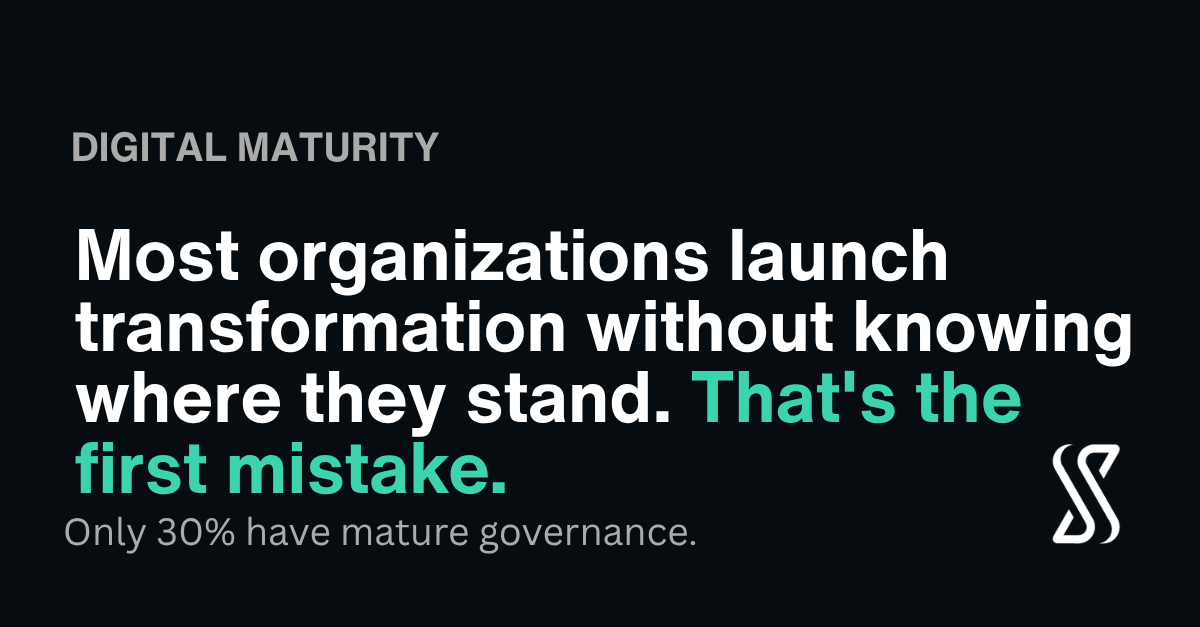

Most organizations launch transformation without knowing where they actually stand. That is the first mistake.
Digital maturity is not a state you declare: it is the result of an honest assessment of real capabilities across five dimensions. Without that diagnostic, any transformation roadmap starts from an unstable foundation.
Reading time: 12 minutes | Keywords: digital maturity, digital maturity models, capability assessment, digital transformation, transformation roadmap
| Key Takeaways |
Only 30% of organizations have mature governance, yet governance maturity is the dimension that most strongly correlates with transformation success or failure (Strolling Digital internal benchmarking).
|
Digital transformation has become table stakes for competitive survival. Yet many organizations launch transformation initiatives without honestly assessing where they actually stand relative to required capabilities. This gap between ambition and readiness creates predictable failure points: under-resourced initiatives, misaligned expectations between business and technology, capability gaps discovered mid-project, and ultimately, outcomes that don't justify the investment.
Digital maturity models provide diagnostic frameworks that enable honest assessment of transformation readiness. Rather than assuming capability, organizations assess actual capabilities across multiple dimensions. This assessment reveals where genuine gaps require development before advancing to subsequent phases. It enables realistic roadmap development aligned to actual organizational capabilities. Most importantly, it prevents the most common trap: assuming readiness that doesn't exist.
Organizations that assess digital maturity honestly and develop targeted roadmaps addressing identified gaps achieve dramatically better transformation outcomes. They avoid capability traps where inadequate foundational capabilities cause repeated project failures. They allocate resources more effectively, focusing investments on highest-impact gaps. They develop more realistic timelines, avoiding the schedule pressure that leads to corner-cutting and poor-quality implementations.
Comprehensive digital maturity models assess capability across five integrated dimensions, each requiring distinct development approaches. Organizations typically have uneven maturity across dimensions: strong in some areas, weak in others. This unevenness creates constraint dynamics where weaker dimensions limit overall transformation potential.
The strategy dimension assesses whether organizations have clear transformation visions aligned to business objectives, and whether strategy translates effectively to operational initiatives. Only 40% of organizations report having transformation strategies sufficiently prepared to guide implementation (Strolling Digital internal benchmarking). Without clear direction, transformation initiatives accumulate conflicting priorities and lose coherence.
Maturity in this dimension includes a clear articulation of why digital transformation matters to the business, explicit business objectives with measurable targets, leadership alignment on strategic direction, and integration of digital strategy with overall business strategy rather than treating it as a separate initiative.
The governance dimension assesses whether organizations have established decision-making frameworks, accountability structures, and organizational designs supporting digital transformation. Only 30% of organizations report mature governance capabilities (Strolling Digital internal benchmarking). This immaturity manifests in very concrete ways: unclear decision authorities, conflicting priorities across departments, accountability confusion, and initiative drift as leadership changes.
"Governance maturity is the factor that most strongly correlates with transformation success, and the one most systematically underestimated in planning." — Natalia Perrone, Founder, Strolling Digital
Maturity in this dimension includes clearly defined governance structures, roles and responsibilities, decision-making authorities and escalation processes, a transformation management office coordinating initiatives, and regular review rhythms that enable course correction before problems escalate.
The infrastructure dimension assesses whether organizations have technology architectures supporting digital capabilities: cloud infrastructure, API-driven integrations, microservices capabilities, and cybersecurity foundations. Approximately 43% of organizations report mature infrastructure capabilities (Strolling Digital internal benchmarking). This is more mature than governance or data capabilities, but still represents significant gaps for the majority.
Infrastructure maturity includes cloud-native capabilities, API-driven integration architecture enabling application connectivity, scalability for growth, disaster recovery and business continuity, and monitoring that enables sustained operational excellence.
The data dimension assesses whether organizations have mature capabilities to manage, access, and leverage their data: data governance, access infrastructure, analytics platforms, data quality, and organizational literacy to work with it. Only 40% of organizations report data capabilities approaching maturity (Strolling Digital internal benchmarking). This represents a critical gap because modern transformation increasingly relies on data-driven decision-making — and without that foundation, digitization projects generate information no one knows how to interpret or use.
Data maturity includes governance frameworks defining ownership and stewardship, quality standards ensuring reliability, unified data platforms or lakehouse architecture, analytics capabilities, and above all, the development of data literacy in the teams that must make decisions with that information.
The talent dimension assesses whether organizations have built required skills, attracted specialized talent, and developed cultural orientations supporting digital transformation. Only 20% of organizations report mature talent and culture capabilities (Strolling Digital internal benchmarking). This is consistently the least mature dimension. Organizations that recognize talent gaps invest in development, yet this dimension remains the one that most constrains the pace of transformation.
Talent maturity includes clear identification of skills required for digital work, strategies for attracting specialized profiles, training and reskilling programs, leadership prepared to guide teams through transformation, and a culture that tolerates experimentation and learning from failure. Notably, only 1% of organizations rate their AI strategy maturity as achieved, despite AI being central to modern digital transformation (Strolling Digital internal benchmarking).
Honest maturity assessment requires a systematic process across all five dimensions. The goal is not to showcase achievement: it is to identify genuine gaps that need attention before committing resources to the next phase.
Establish maturity level definitions applicable to your organization. A simple model uses five levels: Ad Hoc (minimal capability), Repeatable (basic capability with inconsistent processes), Defined (standardized processes enabling consistent capability), Managed (measured processes with control mechanisms), and Optimized (continuous improvement orientation). Tailor definitions to your specific context.
For each dimension, honestly assess current capability level. Conduct the assessment cross-functionally: include perspectives from technology leadership, business unit leaders, finance, and talent development. Different areas have different perceptions of actual maturity. Surfacing those differences and discussing them is part of the value of the exercise.
Compare your assessment against industry benchmarks and competitive positioning. Are you ahead of or behind peers? Where do you have competitive advantages to leverage? Where do you face disadvantages requiring priority investment? External perspective calibrates the assessment and helps identify which gaps are urgent and which are structural.
Define target maturity levels for each dimension based on what your business strategy actually requires. Not all organizations need the same maturity profile. A manufacturing company's data priorities differ from a financial services firm's. Targets must be aligned to what your strategy genuinely needs, not to a generic standard of excellence.
The distance between current state and target is the work map. Prioritize gaps where the capability deficiency constrains the development of other dimensions, where the gap threatens competitive positioning, where investment delivers ROI within a reasonable horizon, and where the organization has the readiness for that investment to succeed.
Assessment is diagnostic. Execution addresses gaps through deliberate capability building. Organizations that successfully build digital maturity advance across multiple dimensions simultaneously, not sequentially.
Develop a clear transformation vision that answers why digital transformation matters to your business and what success looks like. Translate it to explicit, measurable business objectives. Conduct business modeling identifying which capabilities drive value. Build roadmaps that sequence investments explicitly. Communicate strategy throughout the organization and establish a regular rhythm of review and update.
Establish governance structures that clearly define who decides what. Create a transformation management office to coordinate initiatives. Define roles and responsibilities with genuine accountability. Establish approval processes and escalation paths. Create steering committees with real executive sponsorship. Set regular review rhythms that allow you to assess progress and correct course before problems escalate.
Move toward cloud architectures that reduce dependence on on-premise infrastructure. Adopt modern architecture approaches (microservices, containers, serverless) that enable scalability and agility. Implement API-driven integration architecture. Reinforce cybersecurity foundations. Incorporate infrastructure as code practices to enable automation. Invest in monitoring and observability as the foundation of operational excellence.
Establish data governance frameworks defining ownership and stewardship. Implement data quality practices ensuring reliability. Adopt modern data platforms enabling accessibility. Build analytics capabilities. Develop data literacy across teams. Protect sensitive data with appropriate security and privacy frameworks. Ensure the data function supports all business areas, not just IT.
Start with a skills assessment identifying genuine capability gaps. Develop recruiting strategies for specialized profiles (data scientists, cloud architects, UX designers). Build training and reskilling programs for existing teams. Prepare leaders to guide teams through transformation. Develop a culture that tolerates experimentation. Implement change management that helps teams navigate the transition. Ensure continuity with succession planning.
Maturity assessment only delivers value if conducted honestly. Several pitfalls can undermine assessment accuracy.
Organizations often rate their own maturity higher than external assessment would justify. This bias leads to underestimating capability gaps and setting unrealistic roadmaps. Mitigate through external assessment from consultants with experience across organizations. External perspective calibrates internal assessment and identifies blind spots.
IT may assess infrastructure maturity while business leaders assess strategy maturity independently. These separate assessments often diverge significantly. Ensure assessment involves diverse perspectives from technology, business, finance, and other functions. Surface and reconcile differences to reach realistic consensus.
Generic maturity assessment doesn't account for differences in requirements. A startup's required maturity profile differs from an established enterprise's. Tailor assessment to your industry, competitive positioning, and strategic objectives rather than applying a generic benchmark.
Many organizations assess maturity then shelve results without taking action. Assessment only delivers value when findings directly inform transformation planning and capability development priorities. Ensure assessment leads to explicit roadmaps addressing identified gaps.
Digital maturity assessment is not a compliance exercise or a capability audit focused on documenting current state. It is a strategic diagnostic that identifies real capabilities and gaps requiring attention. Organizations that conduct it honestly and develop roadmaps targeted at closing identified gaps build real, sustainable digital advantages.
The organizations winning the digital transformation race are not necessarily those with the most advanced technology. They are those with the most mature capabilities across the five dimensions that determine whether a transformation can be executed: strategy, governance, infrastructure, data, and talent.
"Organizations that assess their digital maturity before transforming avoid the most predictable failure points. Those that don't discover them mid-project, when the cost of correction is much higher." — Natalia Perrone, Founder, Strolling Digital
Whether you're launching transformation for the first time or navigating mid-journey challenges, maturity assessment provides the diagnostic foundation enabling more strategic decision-making, more effective resource allocation, and more realistic timelines.
Do you know where your organization actually stands before committing to your next transformation investment?
At Strolling Digital, we help organizations conduct honest maturity assessments, identify critical gaps, and develop roadmaps that can be executed. Let's talk.
A digital maturity model is a diagnostic framework that allows organizations to assess their current capabilities across multiple dimensions before committing resources to transformation initiatives. Rather than assuming readiness, the model reveals where genuine gaps exist and what capability development is needed before advancing to subsequent phases.
The five dimensions are: strategy and organizational alignment, governance and organizational design, technology infrastructure and architecture, data capabilities and analytics, and talent, culture, and organizational capability. Each requires distinct development approaches and weakness in any one limits overall transformation potential.
Governance defines who decides what, who is accountable for what, and how priority conflicts are resolved. Its absence or immaturity manifests directly in projects that lose direction when leaders change, budgets that don't align to real priorities, and initiatives no one claims ownership of when results don't arrive. It is the dimension that most strongly correlates with transformation success or failure, yet only 30% of organizations report mature governance capabilities (Strolling Digital internal benchmarking).
Because building talent capabilities requires time, sustained investment, and cultural changes that aren't resolved with a single hire or an isolated training program. Organizations tend to prioritize infrastructure and technology because they generate more visible results in the short term, while talent and culture development has longer horizons and is harder to measure. Only 20% of organizations report mature talent and culture capabilities (Strolling Digital internal benchmarking).
The process involves five steps: define maturity levels applicable to your context, assess current state across the five dimensions with cross-functional perspectives, compare with industry benchmarks, establish target maturity levels per dimension aligned to business strategy, and identify gaps and prioritize capability development based on impact and urgency.
No. Sequential development is one of the most common errors. The five dimensions are interdependent and must be developed simultaneously, with intensity appropriate to the gaps identified in each. Waiting for perfect infrastructure before working on governance or talent is a way of indefinitely postponing real transformation.
Not necessarily the most advanced technology or the largest budget. The organizations that achieve their transformations are those with more mature capabilities across the five dimensions: they know where they start from, have governance that sustains decisions, infrastructure that can execute what strategy requires, data that informs decisions, and teams with the skills and culture to sustain change.