Project Management

Why 70% of digital transformations fail and what structure changes the outcome
Digital project delivery at scale: 70% of initiatives fail to deliver intended business value. The root cause isn't technology or budget; it's how we structure governance and measure success.
Reading time: 8 minutes | Keywords: digital transformation at scale, program management, IT governance, digital PMO, digital project delivery
| Key Takeaways |
70% of digital transformations fail to achieve their strategic objectives (McKinsey & Company, 2018). The problem isn't technological — it's organizational.
|
Let's start with an uncomfortable truth. Most digital transformation initiatives fail. Not just miss their timelines or exceed their budgets: they fail to deliver the intended business value. The research is consistent and persistent. 70% of transformations fail to achieve their strategic objectives (McKinsey & Company, 2018).
The conventional explanations are unsatisfying. Technology wasn't ready. Budget constraints forced compromises. Requirements changed. Stakeholders resisted. These are real issues, but they're not the root cause. The root cause is organizational: we treat digital transformation as a project when it's actually an organizational change, and we structure it accordingly.
A project has a defined scope, timeline, and budget. A transformation doesn't. A transformation redefines how the organization operates, how work flows, how people collaborate. It's discontinuous change across multiple dimensions: technology, process, people, culture. No amount of traditional project management methodology can manage that effectively.
The single biggest predictor of transformation success is program size. Not technology choice. Not methodology. Not budget. Size.
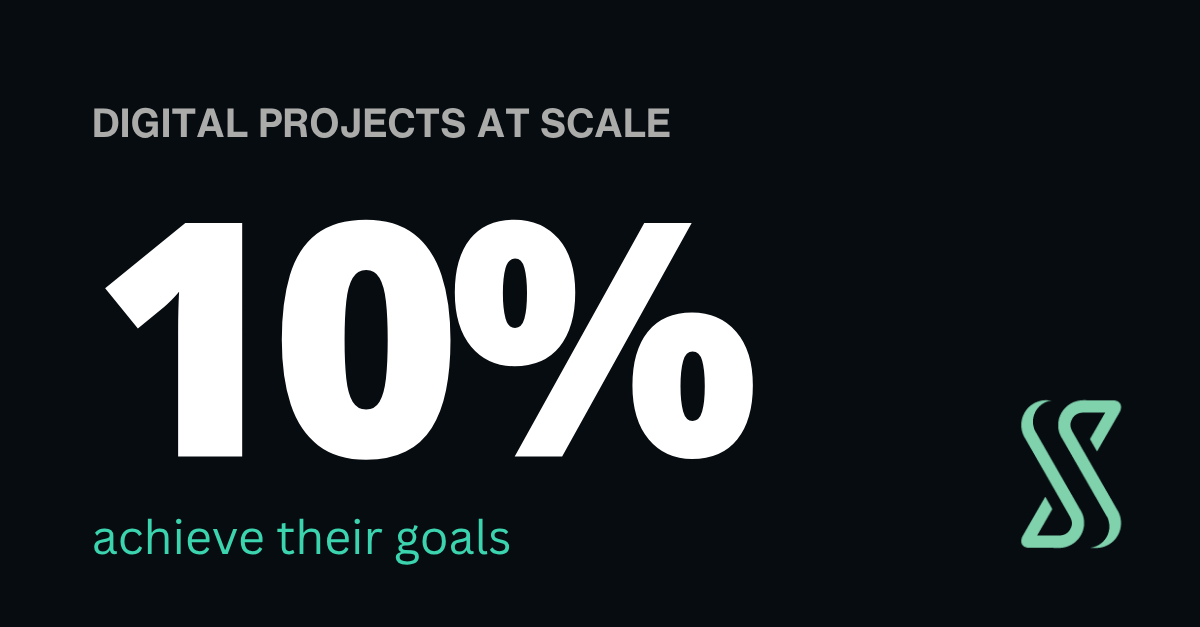
90% of small digital initiatives (less than $2M, less than 12 months, less than 50 people) deliver their intended business outcomes. Compare that to large monolithic transformation programs (over $50M, 18+ months, 200+ people): only 10% deliver their intended outcomes (Strolling Digital internal benchmarking).
This isn't coincidence. There's something about scale that breaks traditional program management approaches. Add more people and coordination becomes exponentially harder. Extend the timeline and requirements become obsolete before delivery. Increase budget and organizational politics make coherent decision-making very difficult. You can't manage your way out of complexity with process; the process itself becomes the problem.
The organizations figuring out digital transformation aren't the ones scaling massive monolithic programs. They're breaking transformation into smaller, semi-autonomous delivery streams, delivering value continuously, and learning and adapting as they go.
How you structure governance for a transformation program dramatically affects outcomes. Most organizations inherit governance models designed for stable, structured projects. Those models don't work for transformation: they create bottlenecks, slow decision-making, and disconnect strategy from execution.
The key is clear decision authority at each layer: strategic decisions made at the strategic layer and execution decisions delegated to streams. Most organizations do the opposite: they centralize execution decisions and delegate strategic thinking downward. That creates slow, disconnected decision-making.
What separates successful transformations from failed ones is how they measure success. Failed transformations measure success by project metrics: on-time, on-budget, on-scope. Successful ones measure by value metrics: business outcomes, capability building, stakeholder value realization.
This shift changes everything. Traditional metrics ask: Did we deliver what we planned? Value metrics ask: Did we deliver what matters to the business?
Organizations that measure success this way make fundamentally different decisions. They're willing to reprioritize streams if the strategic context changes. They invest in capability building even if it slows near-term delivery. They measure transformation success by value realization, not project closure.
Organizations with digital, outcome-focused PMOs dramatically outperform those with traditional governance structures. They are 33% more likely to complete transformation initiatives on schedule and achieve a 42% improvement in stakeholder alignment and value realization when programs are governed by digitally-enabled PMOs (Strolling Digital internal benchmarking).
Why? Digital PMOs operate fundamentally differently. They have real-time visibility into program health, not monthly status reports. They use data to identify risks early, not post-mortems to explain failures. They empower stream teams with autonomy while maintaining strategic coherence. They measure success by value, not by project metrics.
"The transformation programs that work aren't the ones with the most comprehensive governance processes. They're the ones that use governance to enable decision-making, not constrain it. That requires a different kind of PMO, one focused on value delivery, not compliance." — Natalia Perrone, Founder, Strolling Digital
The organizations successfully delivering digital transformations at scale share common structural characteristics. They use delivery models that balance multiple imperatives:
This requires PMO leadership that understands not just project management, but transformation management: leadership that can manage the tension between structure and flexibility, between speed and quality, between immediate value and long-term capability.
Digital transformation success requires a different kind of leadership than traditional project management. Transformation leaders need four capabilities that rarely coexist in a single profile:
This skillset differs significantly from traditional project management. Many organizations promote excellent project managers into transformation leadership roles and are surprised when they struggle. The competencies partially overlap but are fundamentally different.
The organizations that successfully transform do six things consistently:
Digital transformation is one of the hardest things organizations attempt. The failure rate is high. But the success rate for organizations that structure and manage transformations thoughtfully is dramatically better.
It requires different thinking about governance. Different metrics for success. Different leadership capability. But the payoff for organizations that successfully transform their digital capabilities is enormous.
The organizations winning in 2026 aren't the ones that execute perfect projects. They're the ones that successfully navigate the complexity and uncertainty of organizational transformation. That means governance focused on strategy and value, leadership that balances structure with flexibility, speed with quality, immediate results with long-term capability. That's the transformation opportunity worth pursuing.
Is your organization treating digital transformation as a project when it should be managed as an organizational change?
At Strolling Digital, we support transformation programs from strategic governance to measurable value delivery. Let's talk.
The root cause isn't technological or budgetary, it's organizational. Transformations are managed as projects with defined scope, timeline, and budget, when in reality they are discontinuous changes across multiple dimensions: technology, process, people, and culture. Traditional project management methodologies aren't designed to handle that complexity (McKinsey & Company, 2018).
At larger scale, coordination becomes exponentially harder, requirements become obsolete before delivery, and organizational politics make coherent decision-making very difficult. Monolithic programs over $50M have only a 10% success rate, while initiatives under $2M and 12 months achieve their intended outcomes 90% of the time (Strolling Digital internal benchmarking).
It's a structure that separates decision authority across three levels: the strategic layer defines priorities and allocates organizational capacity; the program layer orchestrates delivery streams and manages dependencies; and the stream layer executes specific components semi-autonomously. Strategic decisions stay at the top; execution decisions are delegated downward, not the reverse.
Project metrics ask whether you delivered what was planned (on time, on budget, on scope). Value metrics ask whether you delivered what matters to the business: outcome realization, stakeholder perception, organizational capability building, and readiness to sustain change. This shift changes which decisions get made and when.
A digital PMO has real-time visibility into program health, uses data to identify risks early, and empowers stream teams with autonomy while maintaining strategic coherence. This translates into a 33% higher likelihood of completing initiatives on schedule and a 42% improvement in stakeholder alignment, compared to traditional governance structures (Strolling Digital internal benchmarking).
A transformation leader needs comfort making decisions under ambiguity, genuine organizational change management capability, the political acumen to build stakeholder coalitions, and C-level business strategic thinking. These competencies partially overlap with project management but are fundamentally different. Promoting an excellent project manager without these capabilities is one of the most common causes of transformation program failure.