Project Management

Hybrid work is everywhere. But ubiquity is not the same as effectiveness.
88% of employers now offer some form of hybrid or flexible work, yet most implementations are reactive, ungoverned, and quietly failing. The organizations winning the talent war aren't those offering maximum flexibility. They're those with the most intentional hybrid work strategy.
Reading time: 8 minutes | Keywords: hybrid work strategy, structured flexibility, remote work equity, hybrid governance, workforce retention ROI
| Key Takeaways |
Organizations with intentional hybrid strategies achieve 3.2x better retention, 42% higher engagement, and generate 2.1x ROI within 12 months — compared to those with ad-hoc flexibility.
|
Hybrid work has become the dominant organizational model. ADP Research Institute's 2026 Global Workplace Study indicates that 88% of employers worldwide offer some form of flexible work arrangement, a dramatic shift from the pre-pandemic norm of 35%. Yet this apparent victory masks a deeper reality: most hybrid implementations are poorly designed, inadequately governed, and failing to deliver intended benefits.
88%
Employers offering some form of hybrid or flexible work arrangement (ADP Research Institute, 2026)
35%
Employers offering flexible work pre-pandemic (2019)
The distinction between organizational flexibility and strategic hybrid design is critical. Many organizations interpret hybrid work as permission to work from home as desired, without systematic thought regarding collaboration requirements, team cohesion, career development, or productivity optimization. This reactive, unstructured approach creates predictable problems: isolated remote workers, fragmented teams, unclear communication norms, and frustrated in-office and remote employees alike.
"The organizations winning with hybrid work aren't those offering maximum flexibility , they're those with the most intentional strategy. They've thought clearly about when remote work adds value, when in-person collaboration is essential, and how to structure both optimally. That clarity is the competitive advantage."
Research from Strolling Digital comparing organizations with intentional hybrid strategies versus ad-hoc flexibility revealed stark differences in outcomes. Structured hybrid organizations achieved 3.2x better retention, 42% higher engagement, and 28% higher productivity compared to those with ad-hoc flexibility.
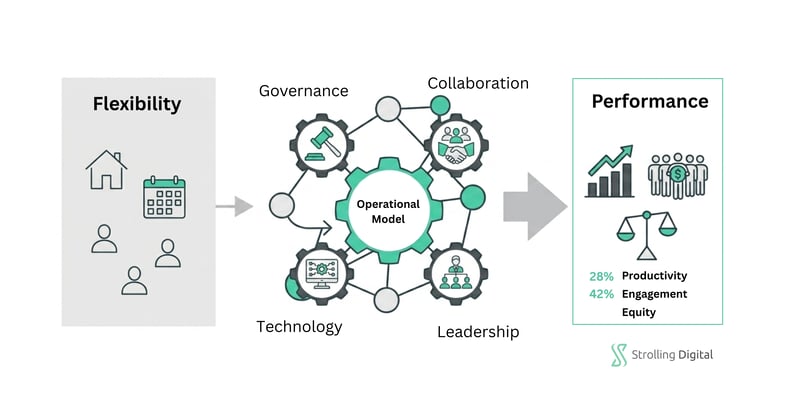
Flexibility alone is passive. To generate real value, it must be channeled through an intentional operational model. This diagram illustrates how governance, technology, and leadership act as the central mechanism that transforms hybrid work into a multiplier of productivity and organizational equity.
Hybrid work effectiveness depends entirely on structure. Organizations that thoughtfully design hybrid arrangements with clear policies, deliberate in-office days, documented collaboration norms, and appropriate technology infrastructure see dramatically better outcomes than those assuming flexibility will self-organize.
McKinsey's 2025 hybrid work research examining 1,400 organizations identified critical governance elements that separate high-performing hybrid organizations from struggling ones:
Vague policies create inconsistency, resentment, and perceived unfairness. High-performing hybrid organizations establish explicit policies addressing: location expectations by function, required in-office days, exceptions and approval processes, core collaboration hours, and technology norms. Written policies create transparency and accountability.
Successful hybrid organizations designate specific days or time blocks when teams are expected to be in-office for collaborative work. Rather than assuming people will self-coordinate, they structure collaborative time deliberately. Common models include: all-hands days (monthly), team collaboration days (weekly), or core hours when remote collaboration is expected.
3.2x
Better retention for organizations with intentional hybrid strategies vs. ad-hoc flexibility (Strolling Digital Research, 2026)
Without explicit communication norms, hybrid teams develop inconsistent patterns: some synchronous, some asynchronous, some fragmented. High-performing organizations document expectations: when synchronous communication is required, which tools to use for which purposes, response time expectations, and decision-making processes for async-friendly organizations.
Hybrid work requires sophisticated technology infrastructure enabling seamless hybrid meetings, document collaboration, and asynchronous communication. Organizations implementing well-designed tech stacks see dramatically better collaboration experiences. Organizations treating technology as afterthought create frustrating experiences that undermine hybrid work benefits.
Managers represent the critical implementation layer. Successful hybrid organizations train managers on hybrid leadership, how to lead remote and in-office team members, ensure inclusive collaboration, prevent remote worker marginalization, and optimize team time together. Organizations without manager training see managers defaulting to problematic patterns: favoring in-office employees, excluding remote members from key decisions, and more.
34%
Lower productivity for organizations with poorly structured hybrid systems lacking governance (McKinsey, 2025)
2.4x
Higher stress levels for employees in unstructured hybrid environments (Gallup, 2025)
One of the most persistent challenges in poorly designed hybrid systems is the marginalization of remote workers. Employees working primarily from home often experience reduced visibility, fewer career advancement opportunities, and social isolation, even in organizations ostensibly offering equal flexibility.
Harvard Business Review research tracking hybrid team dynamics identified the 'availability bias': managers unconsciously favor employees they see in-office, assigning them higher-visibility projects, including them in informal decision-making, and championing them for advancement. Remote employees, despite equal performance, receive fewer opportunities and lower visibility.
52%
More isolation reported by remote employees in poorly designed hybrid systems (Harvard Business Review, 2025)
41%
Lower career advancement perception for remote employees in unstructured hybrid environments (ADP, 2026)
Well-designed hybrid systems eliminate these gaps through:
Organizations addressing remote worker equity systematically see no difference in engagement, advancement opportunity perception, or outcomes between remote and in-office employees.
Beyond engagement and productivity benefits, hybrid work generates substantial financial returns. Organizations implementing structured hybrid strategies capture value through multiple mechanisms:
Structured hybrid arrangements reduce space requirements. Organizations don't eliminate offices , they reduce them. Rather than assigned desks for everyone, they implement hot-desking, activity-based working, or flexible space allocation. Research from CoreNet Global indicates that well-designed hybrid transitions reduce real estate footprint by 15–25%, generating 20–25% savings on occupancy costs.
22%
Reduction in real estate costs through strategic hybrid work arrangements (CoreNet Global, 2025)
Hybrid flexibility dramatically expands talent pools. Organizations offering strategic hybrid work access candidates they previously couldn't reach, people unwilling to relocate, those in high cost-of-living areas seeking remote-friendly options, and those unable to work in traditional office environments. Studies from LinkedIn show organizations offering hybrid work attract 58% more qualified applicants and see 34% improvement in recruitment cycle time.
58%
Increase in qualified applicants for organizations offering strategic hybrid work (LinkedIn, 2026)
Flexible work ranks among the top three reasons employees stay with employers. Organizations offering structured hybrid work reduce voluntary turnover by 28% on average. For a 5,000-person organization, a 28% reduction in turnover represents approximately 200 fewer exits annually, generating $22 million in avoided replacement costs.
Combining real estate savings, recruitment efficiency, and retention improvement, organizations implementing structured hybrid arrangements generate 2.1x ROI within 12 months of implementation. For organizations investing $3–5 million in hybrid work infrastructure and governance, returns of $6–10 million within the first year are typical.
2.1x
ROI within 12 months for organizations implementing structured hybrid work with strong governance (Strolling Digital Analysis, 2026)
Designing effective hybrid work requires a systematic approach addressing technology, governance, culture, and management capability. Organizations implementing these elements typically transition from reactive flexibility to strategic hybrid advantage:
Step 1 — Define Hybrid Model and Location Expectations: Decide which hybrid model aligns with organizational strategy: distributed teams working fully remote with occasional in-person gatherings, core-hours model with flexibility on timing, team-defined patterns based on collaboration requirements, or role-specific approaches based on job functions. Different models serve different organizational contexts, choose the one aligned with your strategy, not the one offering maximum flexibility.
Step 2 — Establish Clear, Written Policies: Document expectations explicitly: where people work, when in-office presence is required, approval processes for exceptions, what constitutes core hours, and technology standards. Write these down. Vague policies create inconsistency and resentment.
Step 3 — Design Intentional Collaboration Time: Determine when teams work together in-office. This might be monthly all-hands days, weekly team collaboration sessions, or defined core hours. Make these intentional and meaningful — don't waste in-person time on meetings that could be asynchronous.
Step 4 — Invest in Collaboration Technology: Implement high-quality video conferencing, async communication tools, document collaboration platforms, and project management systems. Make hybrid meetings genuinely inclusive — not in-office employees joining calls while sitting next to remote colleagues.
Step 5 — Train and Develop Managers: Manager capability is essential. Train managers on hybrid leadership: inclusive decision-making, preventing remote bias, developing remote reports, and optimizing synchronous and asynchronous team time.
Step 6 — Communicate and Monitor: Communicate the hybrid strategy clearly and repeatedly. Monitor execution — ensure managers follow policy, teams experience inclusion equity, and remote workers feel connected and valued.
The hybrid work era is not a temporary transition, it's the operating model for the foreseeable future. Organizations that view hybrid work as a cost-cutting measure or temporary flexibility are missing the strategic opportunity. The real advantage comes from intentional hybrid design that optimizes for collaboration, innovation, flexibility, and engagement.
Organizations that master hybrid work with clear governance, deliberate collaboration design, equity focus, and technology enablement, will capture disproportionate talent advantage. They'll attract talent that others can't reach, retain talent better, and create more engaged, productive workforces.
For enterprise leaders in 2026, the question is no longer whether to offer hybrid work. That's table stakes. The question is whether your organization will design hybrid work strategically or continue with reactive ad-hoc flexibility. That distinction will define competitive advantage in the talent war for the next decade.
Is your hybrid work model built for competitive advantage or just for compliance?
If your organization is navigating the shift from reactive flexibility to intentional hybrid design, Strolling Digital can help you build the governance, culture, and technology strategy to do it right. Let's talk.
Hybrid work refers to any arrangement where employees split time between remote and in-office settings. An intentional hybrid strategy goes further: it defines clear policies, designates deliberate collaboration time, establishes communication norms, and invests in technology and manager training. Organizations with intentional strategies achieve 3.2x better retention and 42% higher engagement than those with ad-hoc flexibility.
In poorly designed hybrid systems, remote employees experience 52% more isolation due to the 'availability bias' — managers unconsciously favor those they see in-office for high-visibility projects and advancement opportunities. Well-designed hybrid systems counter this through intentional inclusion, transparent project assignment, and explicit manager accountability.
Organizations implementing structured hybrid arrangements generate 2.1x ROI within 12 months. This comes from three sources: a 22% reduction in real estate costs, a 58% increase in qualified applicants, and a 28% reduction in voluntary turnover — which for a 5,000-person company translates to approximately $22 million in avoided replacement costs annually.
According to McKinsey's 2025 research across 1,400 organizations, the five critical governance elements are: (1) clear, written hybrid policies; (2) intentional synchronous collaboration time; (3) documented communication norms; (4) investment in collaboration technology; and (5) structured manager training and accountability.
According to ADP Research Institute's 2026 Global Workplace Study, 88% of employers worldwide now offer some form of flexible or hybrid work, up from 35% before the pandemic. However, most of these implementations lack the governance and intentional design needed to capture the full benefits.