Project Management

From pilot to standard: how Microsoft Copilot reshaped enterprise productivity
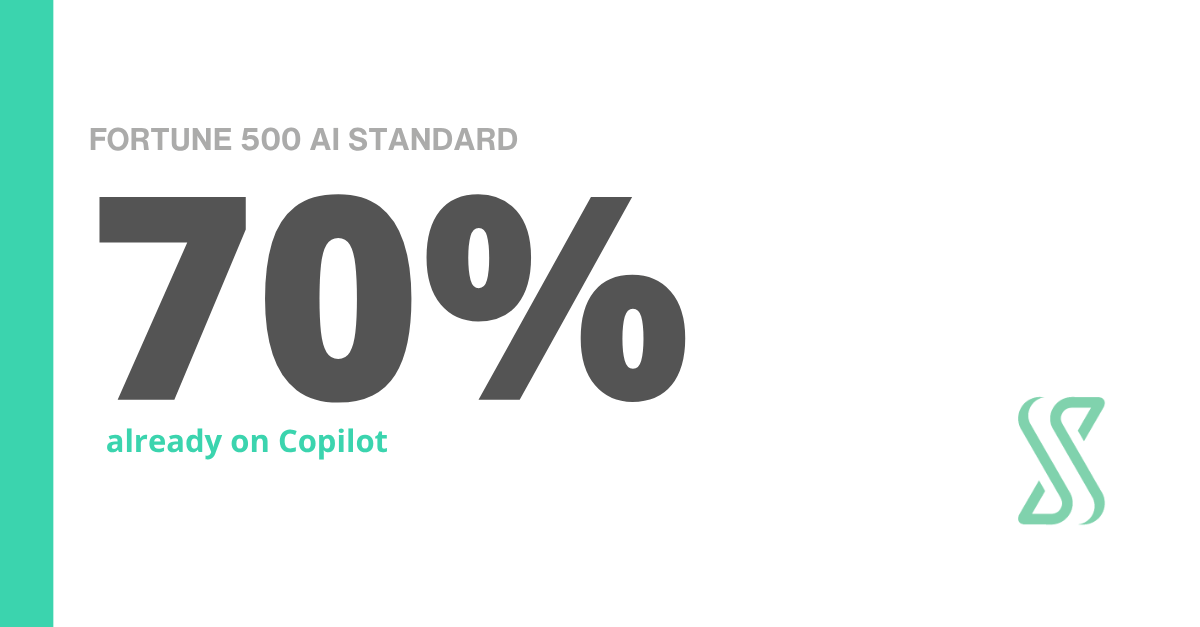
Microsoft Copilot has moved from experimental pilot to enterprise standard at a pace that surprised even optimistic industry observers. Today, 70% of Fortune 500 companies have adopted it and the productivity results are reshaping what knowledge work looks like.
Reading time: 9 minutes | Keywords: Microsoft Copilot, Fortune 500, enterprise AI productivity, GitHub Copilot, workplace automation, digital transformation
| Key Takeaways |
70% of Fortune 500 companies have adopted Microsoft Copilot, automating 40% of routine tasks and freeing knowledge workers for higher-value strategic work.
|
We are witnessing a fundamental shift in how enterprises approach artificial intelligence. For decades, AI remained largely experimental a technology that captured imagination but struggled with practical workplace integration. Today, Microsoft Copilot has changed that narrative entirely. What began as a pilot program has rapidly evolved into a standard productivity tool across the largest corporations in the world.
The numbers tell a compelling story. Seventy percent of Fortune 500 companies have now adopted Microsoft Copilot in some capacity. This is not a gradual adoption curve, this is wholesale transformation. These are companies that typically move cautiously with new technologies, yet they have embraced Copilot at a pace that surprised even optimistic industry observers. This acceleration reflects something profound: enterprises are finally seeing tangible ROI from AI investments.
"Microsoft Copilot represents the moment when artificial intelligence transitioned from laboratory experiment to essential workplace tool."
The Copilot ecosystem extends beyond a single application. Microsoft has embedded these AI assistants across its Office suite — Word, Excel, PowerPoint, Outlook, and Teams — creating an integrated intelligence layer throughout organizations. This horizontal distribution of AI capabilities means employees encounter Copilot naturally, within the tools they already use daily. There is no special interface to learn, no new platform to master. Copilot meets knowledge workers where they work.
When we say that 40% of routine workplace tasks are being automated, it is important to understand what this means in practice. This is not science fiction automation where robots replace entire departments. Rather, it is surgical automation of specific task components that drain productive time without requiring human judgment.
The liberation effect of this automation is significant. Consider a marketing manager who previously spent 8 hours weekly on email management and initial content drafting. With Copilot, these tasks compress to 3–4 hours. That recovered time — often 10–15 hours monthly per employee — redirects to strategy development, creative thinking, and business innovation. When multiplied across an organization of thousands, the aggregate impact on strategic capacity is substantial.
40% of routine workplace tasks automated through Copilot integration, according to Microsoft and Deloitte analysis of enterprise deployments.
If there is one Copilot success story that deserves special attention, it is GitHub Copilot. Launched in 2021 as a technical preview for developers, it has become the most widely adopted AI development tool in history. Twenty million developers now use GitHub Copilot regularly, and the adoption curve shows no signs of flattening.
Among enterprise developers, those working at Fortune 500 and Fortune 100 companies, adoption is even more pronounced. Ninety percent of Fortune 100 companies report active GitHub Copilot deployment. This is remarkable when you consider that many of these organizations have rigorous security, compliance, and procurement requirements that typically slow new tool adoption.
"GitHub Copilot has fundamentally changed the economics of software development, reducing routine coding work while elevating the role of the developer as architect and strategist."
What explains this explosive adoption? Developers experienced immediate, tangible productivity gains. Copilot does not simply suggest code snippets, it understands project context, architectural patterns, and coding standards. It adapts to individual developer preferences and team conventions. The AI learns from each interaction, becoming more helpful over time. For senior developers, it eliminates the tedious work of writing boilerplate and test scaffolding. For junior developers, it serves as an always-available mentor, teaching coding patterns and best practices through examples.
The business impact is equally clear. Organizations report a 35–50% reduction in time spent on routine coding tasks. More importantly, they report measurably fewer bugs in production, because Copilot suggests code that follows established patterns and best practices. Security vulnerabilities have decreased as Copilot steers developers away from common exploitable patterns. Code review cycles have shortened because generated code is generally of high quality.
The enterprise AI productivity tools market has reached a valuation milestone: $125 billion in 2025, with projections suggesting it could double by 2028. This is not hype or speculative valuation. This represents actual spending by organizations deploying real AI tools that produce measurable ROI.
What is driving this market expansion? Several factors converge.
First, the technology has matured. Early AI tools promised much but delivered inconsistently. Modern Copilot assistants have reliability approaching 90% accuracy for their recommended actions. Organizations trust them with increasingly consequential work.
Second, the competitive imperative is real. Companies that master these tools gain measurable advantages in time-to-market, quality, and innovation velocity. The organizations leading their industries — across finance, technology, healthcare, and manufacturing — are investing disproportionately in AI productivity tools. This creates a virtuous cycle where success attracts further investment.
$125 billion — enterprise AI productivity tools market in 2025, growing at 35% annually.
Third, the unit economics have improved dramatically. Early AI implementations required significant technical infrastructure and specialized talent. Today's Copilot deployments run on cloud infrastructure that scales elastically, with pricing models that align costs to value. A Fortune 500 company can deploy Copilot to 10,000 employees within weeks, with licensing costs easily justified by the productivity gains from even small percentages of time saved.
The most important test of any technology is whether it delivers measurable, sustained value. With Copilot, the evidence is compelling. Organizations tracking deployment metrics report consistent improvements across multiple dimensions.
These metrics reveal something important that pure productivity numbers might miss: Copilot is changing how people experience work. The repetitive, mechanical aspects of knowledge work, the parts that feel like administrative burden, are being offloaded to AI. This leaves humans with the parts of work that require judgment, creativity, and strategic thinking. That shift alone drives engagement improvements that show up in retention metrics and internal surveys.
The error reduction data is particularly significant. When developers use GitHub Copilot, they do not only produce code faster. They produce better code. The AI steers them toward patterns that are less prone to vulnerabilities, more maintainable, and more aligned with team standards. This compounds over time: as codebases become more consistent and stable, future development becomes faster and easier. Organizations that embraced GitHub Copilot two years ago are now realizing downstream benefits in reduced technical debt and faster feature delivery.
The 70% adoption rate among Fortune 500 companies did not emerge from universal immediate enthusiasm. The journey from skepticism to standard practice followed a predictable pattern that organizations can learn from.
Early adopters — typically companies in financial services, technology, and consulting — deployed Copilot aggressively. They were motivated by competitive urgency and had technical teams capable of managing rapid integration. Within 6–12 months, these early adopters were publishing case studies and internal metrics showing clear productivity improvements. This created proof points that changed the conversation from "Is this valuable?" to "How quickly can we adopt this?"
Skeptical organizations, particularly those in regulated industries like healthcare, pharmaceuticals, and financial services, moved more cautiously. They had legitimate concerns about AI governance, data privacy, and regulatory compliance. What changed their calculus was seeing peers deploy successfully within regulated environments. Organizations like large pharmaceutical companies and insurance companies realized that Copilot could be deployed securely, with appropriate governance frameworks, within their compliance requirements.
"The transition from AI skeptic to AI adopter typically happens when organizations realize that the competitive cost of not adopting exceeds the risk of adoption."
Today, the remaining 30% of Fortune 500 companies that have not adopted Copilot are primarily those in early stages of cloud migration or those focused on specific use cases that will adopt when proven patterns exist for their industries. This is not resistance, it is appropriate caution followed by adoption once conditions align.
Despite the compelling adoption numbers, implementing Copilot at enterprise scale is not frictionless. Organizations that have successfully scaled deployments share common practices for addressing predictable challenges.
Leading organizations approach these challenges methodically. They start with pilot programs in specific departments, establish governance frameworks before broad rollout, invest in training, and create feedback loops for continuous improvement. This measured approach reduces implementation risk while building organizational capability to work effectively with AI.
The Copilot revolution we are observing today is just the beginning of a broader transformation in how enterprises work with AI. The next phase will likely feature even more specialized AI assistants tailored to specific professional domains industry, specific Copilots for healthcare, financial services, manufacturing, and other sectors. These specialized assistants will be trained on domain knowledge, regulatory requirements, and industry best practices, making them significantly more valuable than general-purpose tools.
We are also seeing the emergence of AI-powered workflow automation that goes beyond individual task assistance. Rather than Copilot helping a single employee complete a task, enterprise automation platforms are using AI to orchestrate multi-step processes across teams and systems. A customer service inquiry that previously required interactions among customer service, billing, and operations teams can now be intelligently routed and processed with AI assistance at each stage, reducing resolution time considerably.
Strolling Digital has observed that organizations making the path to digital easy are not simply implementing tools, they are fundamentally rethinking how work gets organized and executed in an age of AI assistance. The companies winning in this environment are those approaching Copilot and similar tools as catalysts for broader organizational transformation, not just productivity patches.
"The organizations that will thrive in the next phase of digital transformation are those that view AI as an opportunity to reimagine work itself, not simply automate existing processes."
Is your organization ready to move beyond the pilot phase?
At Strolling Digital, we help enterprises design and execute AI adoption strategies that deliver measurable results, from implementation roadmap to ROI tracking. Let's talk.
70% of Fortune 500 companies have adopted Microsoft Copilot in some capacity, making it the enterprise AI tool with the highest recorded corporate adoption rate to date.
Microsoft Copilot automates 40% of routine tasks, including email triage and response drafting (30–45% reduction in processing time), document and meeting summarization, repetitive code generation, data analysis and visualization, and first-draft content creation for marketing teams.
GitHub Copilot has reached 20 million global users, with active deployment reported by 90% of Fortune 100 companies. It is the most widely adopted AI development tool in enterprise software history.
The market reached $125 billion in 2025, growing at 35% annually, with projections suggesting it could double by 2028. This growth is driven by measurable ROI, technological maturity, and competitive pressure across all sectors.
Organizations report a 28–35% reduction in time needed for routine tasks per employee, a 42% improvement in code quality with GitHub Copilot, and 67% of knowledge workers report higher engagement and job satisfaction after adoption.
Key challenges include cultural change management at scale, data governance and privacy guidelines, ROI measurement frameworks, prompting skills development among employees, and defining governance and human oversight policies. Successful organizations address these through pilot programs, pre-rollout governance frameworks, and continuous feedback loops.
The remaining 30% consists primarily of companies in early stages of cloud migration or those waiting for proven implementation patterns to emerge for their specific industries. This reflects strategic caution rather than systematic resistance, adoption typically follows once conditions align.