Digital Transformation
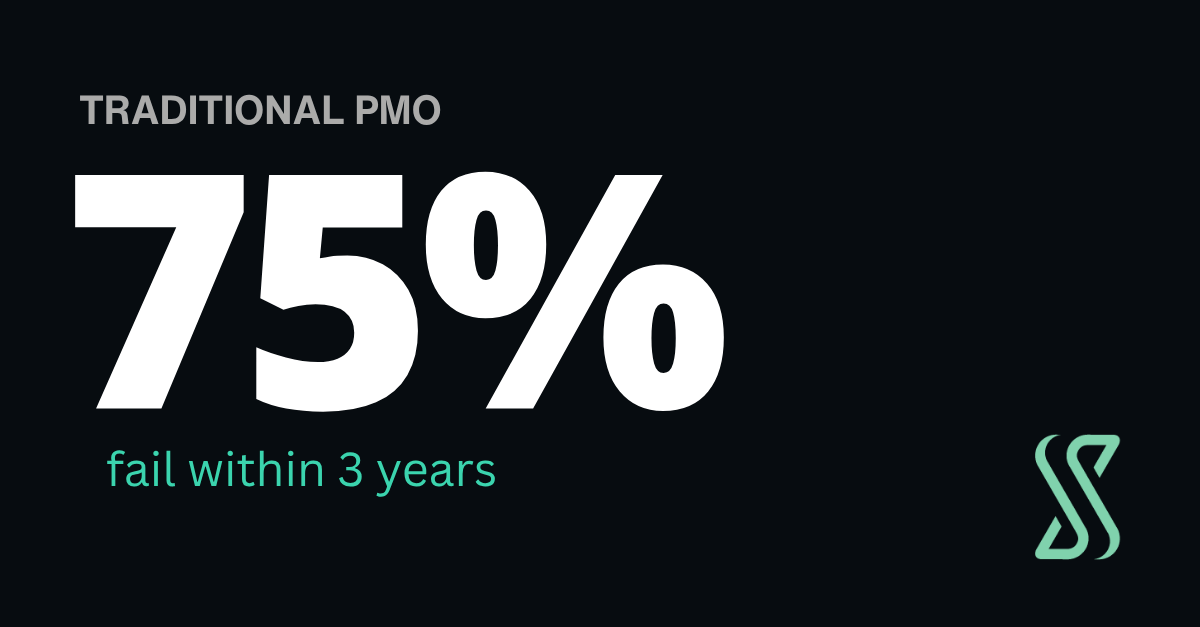

Three out of four PMOs disappear before their third year. The problem is not the execution: it is the model.
The most advanced organizations no longer manage projects: they manage value. The Value Delivery Office is the structural answer to a governance crisis that has been ignored for decades.
Reading time: 11 minutes | Keywords: Value Delivery Office, PMO, digital transformation, portfolio governance, AI in project management, enterprise value delivery
| Key Takeaways |
75% of traditional PMOs fail within their first three years — the problem is not execution, but the governance model itself.
|
The statistics are stark and persistent. PMOs are failing at scale. In organizations around the world, PMOs that were implemented with genuine strategic intent — to bring discipline, consistency, and strategic alignment to project delivery — are being dismantled, bypassed, or fundamentally reimagined. The conventional wisdom that blamed these failures on poor implementation or weak leadership was comforting but wrong. The real problem is more fundamental: we have been optimizing the wrong function for the wrong metrics.
This is not a small problem. It is organizational pathology at scale. When three-quarters of a governance function fail, it suggests the function itself, not its execution, is misaligned with how modern enterprises actually create and deliver value.
75%of traditional PMOs fail within their first three years, defined as being shut down, losing executive sponsorship, or becoming marginalized from strategic decisions. (Strolling Digital, internal benchmarking, 2026)
The traditional PMO was born from a specific context: large, stable organizations with long project timelines, where risk management meant comprehensive documentation and where success meant delivering on the agreed scope, schedule, and budget. These contexts still exist, but they are increasingly rare. The dominant context now is one of continuous uncertainty, rapid change, competing strategic priorities, and the relentless pressure to deliver not just projects but business value.
Before we dismiss traditional PMOs entirely, we need to acknowledge what they contributed. The professionalization of project management, the introduction of standardized methodologies, the creation of a single source of truth for project status, these were genuine advances. They reduced chaos, improved predictability, and created a common language for how organizations talk about delivery.
But the traditional PMO was built around a false assumption: that standardization leads to success. The logic was seductive if we can standardize processes, enforce consistent governance, and create visibility across all projects, success will follow. The reality proved more complex.
These are not execution failures. They are structural problems embedded in the traditional PMO model. No amount of training or tool upgrades will fix them.
Across industries, a new organizational form is emerging. Organizations are transforming their PMOs into what we call Value Delivery Offices, strategic functions that center entirely on maximizing the business value that emerges from the organization's portfolio of work.
The Value Delivery Office operates from a fundamentally different philosophy:
"The traditional PMO asked, 'Are we following the process?' The Value Delivery Office asks, 'Are we creating the value that matters?' This single shift in focus changes everything about how the function operates and how it's perceived by the business."
The shift from PMO to Value Delivery Office is not just a philosophical change. The business impact is substantial and measurable.
33%increase in likelihood of completing digital transformation initiatives on schedule when organizations have outcome-focused, digitally-enabled delivery offices versus traditional PMO structures. (Strolling Digital, internal benchmarking, 2026)
42%improvement in resource utilization efficiency and reduction in duplicate efforts across projects when portfolio governance is centralized in a Value Delivery Office with real-time visibility. (Strolling Digital, internal benchmarking, 2026)
Consider the typical enterprise: multiple strategic initiatives compete for finite resources. Projects run longer than planned because priorities shift. Resources are allocated to legacy initiatives even though strategic priorities have changed. The traditional PMO reports all this accurately but lacks the authority to do anything about it. The Value Delivery Office, by contrast, has both the visibility and the mandate to say: "This project no longer aligns with strategy — we are reallocating these resources."
We have worked with organizations that made this shift and captured remarkable results. One financial services firm reduced their portfolio cycle time from 18 months to 8 months, not by accelerating individual projects but by eliminating misaligned initiatives and concentrating resources on high-value delivery. Another technology company improved their time-to-value by 40% by shifting from a project-centric governance model to a value-centric one. (Strolling Digital, client cases, 2026)
Moving from traditional PMO to Value Delivery Office is not a tool change. It is a fundamental transformation of organizational governance, decision-making authority, and how we define and measure success. It requires:
This is not quick or easy. Organizations that have successfully made this shift invested 12 to 18 months in the transformation and required sustained executive commitment. But the alternative, maintaining a PMO that optimizes for the wrong things, has become increasingly untenable.
Digital-first Value Delivery Offices look dramatically different from their PMO predecessors. They are built on cloud-native platforms, real-time data integration, and increasingly, AI-powered decision support.
80%of leading organizations plan to integrate AI capabilities into their PMO or VDO operations by 2026, focusing on predictive analytics for risk identification and outcome forecasting. (Strolling Digital, internal benchmarking, 2026)
The AI opportunity is not about automating administrative tasks. It is about enabling better strategic decisions. An AI system that can analyze historical outcome data and predict which types of initiatives are likely to deliver their promised value can transform portfolio prioritization. An algorithm that surfaces emerging risks months before they become visible enables proactive adjustment. Predictive resource optimization based on real project data outperforms manual allocation almost every time.
The most mature digital VDOs share a common architecture: a unified data platform that integrates project data, outcome data, and business context data; real-time dashboards that surface portfolio performance against strategic objectives; and increasingly, AI systems that analyze these patterns and recommend actions. This is not "automating the PMO." It is creating the intelligence infrastructure that transforms the office from an administrative function to a strategic engine.
For many organizations, the path forward involves difficult conversations. The PMO that has provided stability and brought discipline to chaotic delivery needs to evolve. The PMO leaders who have built their careers in traditional governance models need to develop new skills. The organization that has relied on the PMO as a neutral arbiter now needs it to have a strategic point of view.
These conversations are necessary. The evidence is overwhelming: traditional PMO models are not fit for how modern enterprises operate. Organizations that are bold enough to reimagine their PMO as a Value Delivery Office — with strategic authority, outcome-based metrics, and digital-first capabilities — are the ones winning in digital transformation. The rest are optimizing for metrics that no longer matter.
If you are leading an organization with a traditional PMO, the question is not whether to transform but how quickly you can execute the transformation. Start by honestly assessing your current state: What metrics is your PMO actually optimizing for? What decisions does it actually have authority to make? How connected is it to strategic decisions about what work matters most? The answers will clarify what needs to change.
Build a transformation roadmap that sequences the key changes: clarifying strategic authority and decision rights, defining outcome-based metrics, investing in data infrastructure and AI capabilities, and transforming the skillsets and organizational positioning of your PMO leadership. This is not a 6-month initiative. But it is an investment that directly impacts whether your organization can successfully execute digital transformation at the pace and scale the market demands. The traditional PMO's time has passed. The Value Delivery Office is ascendant. Organizations that recognize this shift and execute the transformation will dramatically outperform those that cling to governance models designed for a different era.
Is your PMO measuring what truly matters to the business?
If you want to assess your governance maturity and design the path to a Value Delivery Office with real strategic authority, we can help at Strolling Digital. Let's talk.
The primary reason is not poor execution but structural misalignment. The traditional PMO model was designed for a different era: stable organizations, long project timelines, and success defined by scope, schedule, and budget. Its metrics do not capture real business impact, and the function typically lacks the authority to make strategic portfolio decisions, making it ineffective in the context where most enterprises now operate.
The Value Delivery Office is the strategic evolution of the PMO. Instead of tracking project adherence to plan, it focuses on maximizing the business value that emerges from the organization's portfolio of work. It operates with real decision authority over portfolio prioritization, uses outcome-based metrics, and integrates data and AI capabilities as core to its operations, not as add-ons.
The five structural problems are: metric misalignment (measuring time, budget, and scope instead of business value), process over outcomes (checkbox governance instead of impact), portfolio blindness (no authority to prioritize or stop work), stakeholder distance (disconnected from the business units it serves), and talent drain (attracting compliance professionals instead of strategic change leaders). These are design flaws, not execution gaps.
Organizations that have successfully completed this transformation invested between 12 and 18 months. The process requires sustained executive commitment and involves changes across governance, metrics, data infrastructure, and leadership capabilities. It is not a tool change or a rebranding. It is a fundamental redesign of how the organization makes decisions about its portfolio of work.
AI in a VDO is not about automating administrative tasks, it is about improving strategic decisions. AI systems can analyze historical outcome data to predict which initiatives are likely to deliver their promised value, surface emerging risks months before they become visible, and optimize resource allocation based on real project data. 80% of leading organizations plan to integrate these capabilities by 2026. (Strolling Digital, internal benchmarking, 2026)
Available data points to a 33% higher likelihood of completing digital transformation initiatives on schedule and a 42% improvement in resource utilization efficiency. At the client level, organizations have reduced portfolio cycle time from 18 to 8 months and improved time-to-value by 40%. Not by accelerating individual projects but by eliminating misaligned work and concentrating resources where they create the most impact. (Strolling Digital, internal benchmarking and client cases, 2026)
Start with three questions: What metrics is your PMO actually optimizing for? What decisions does it have the authority to make? How connected is it to strategic decisions about which work matters most? If your PMO is measuring on-time and on-budget delivery without a clear link to business outcomes, and lacks authority to stop misaligned projects, the gap between your current model and the VDO is significant.