Gestión del Talento


If your team cannot run what was implemented without the consultant, the transformation starts slipping the day the consultant leaves.
Reskilling to sustain digital transformation is not a training program running alongside the project. It is what decides whether the new system still works six months after go-live.
Reading time: 7 minutes | Keywords: reskilling to sustain digital transformation, post-implementation autonomy, strategic reskilling, interim management, tactical staffing
| Key Takeaways |
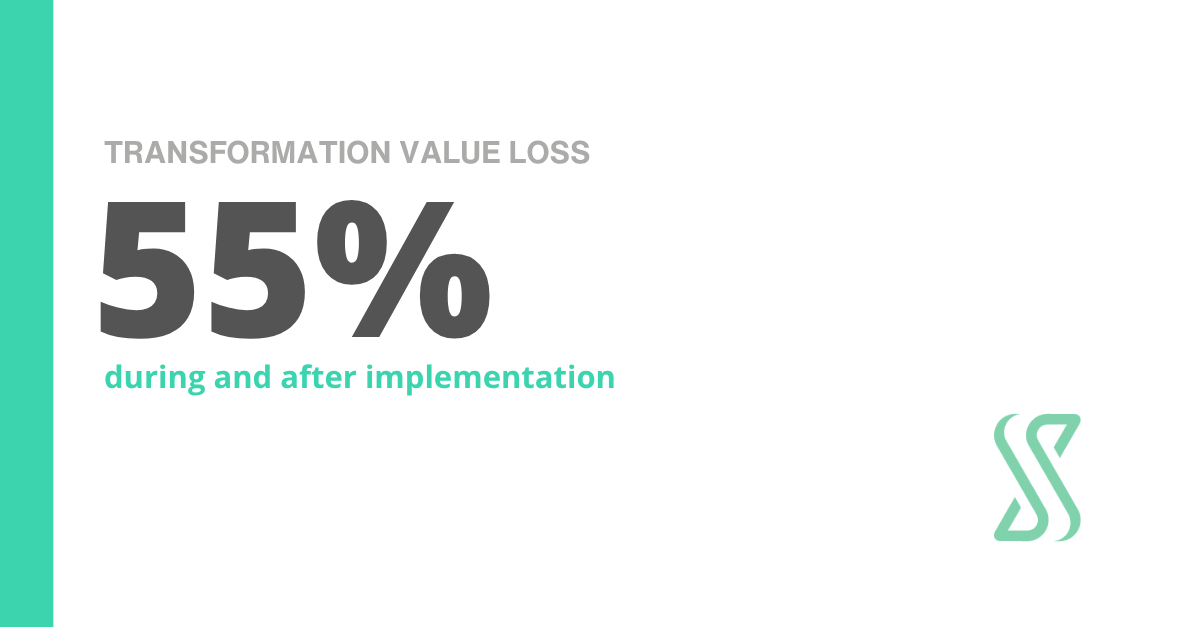
55% of a transformation's value loss occurs during and after implementation, not at the design stage (McKinsey, 2021).
|
McKinsey found that 55% of a transformation's value loss occurs during and after implementation (McKinsey, 2021). We see the same pattern across retail, healthcare, logistics, manufacturing and B2B services. A company rolls out an ERP, a CRM or a new point-of-sale system. The external consultant closes the project with a flawless report. A few weeks later, store managers, plant supervisors or sales teams are back on spreadsheets, because nobody inside the organization knows how to handle the exceptions the system was not designed for. The project is technically finished. The operation is not.
The problem is neither the tool nor the team's willingness. It is that the ability to run, adjust and improve what was built stayed in the head of the person who left. The same thing happens when the person leaving is an operations director or an IT lead with years of context: the knowledge walks out with them, and leadership has to make decisions without knowing exactly what was lost.
This article covers how to design that continuity from day one: what strategic reskilling means, how it differs from filling a gap with temporary profiles, and what operating model gives the team real post-implementation autonomy.
Classic change management focuses on adoption: communicate, train people on the tool, reduce resistance. It is necessary, but it has an expiry date. When the project closes, the change plan closes with it. PMI's latest research shows the cost of that gap: 35% of project professionals cite the disconnect between planning and execution as a top barrier, and only half of projects meet a modern definition of success (PMI, 2025).
What a transformation needs to last is something else: a team that understands why the process was designed the way it was, can tell when it stops working and has the judgment to adjust it without waiting for an external provider. You do not get that from a two-day course before go-live. It is built while the project is still running.
In practice, the difference shows up in very concrete questions. Who decides whether a new pricing rule is configured in the system or handled outside it? Who reads the operations dashboard and acts on it? Who notices that stock the system marks as available has not been on the shelf for three weeks? If the answer to all of them is "the consultant", the organization has not changed its capability. It has rented someone else's. As Harvard Business Review points out, execution failures usually stem not from flawed strategy but from overlooked readiness gaps (Harvard Business Review, 2026).
"A company that depends on the consultant to adjust its own processes has not transformed its capability. It has rented it."
We have seen this up close. In Yves Rocher's POS transformation across Spain and Italy, adoption at every commercial touchpoint depended on store teams owning the new model rather than experiencing it as something the project imposed on them. The logic holds in any sector: technology stabilizes when the people using it understand which problem it solves.
When a key person leaves, or a project needs a capability the organization does not have, the usual reaction is to fill the gap. A temporary profile comes in: an interim manager, an external consultant. It is a reasonable decision and often an urgent one. The mistake is treating it only as an emergency tactic.
Tactical staffing solves immediate continuity: someone makes decisions, the project keeps moving, operations carry on. What it does not solve on its own is what happens when that person's mission ends. If for months they have held the process knowledge, the supplier relationships and the decision-making judgment, their exit recreates the very problem that brought them in. It is not a marginal risk: 63% of employers cite the skills gap as the key barrier to business transformation (World Economic Forum, 2025).
The alternative is to turn every external intervention into a planned handover. An interim manager or external PM comes in with a dual mandate: solve what is urgent, and leave someone internal able to do it afterwards. That changes how the engagement's success is defined. It is no longer measured only by milestones delivered, but by how much the organization still depends on the outsider when they leave.
This is how we work at Strolling Digital. At Essentiel Outsourcing we took on the Interim CIO role. At Unilabs we acted as external PM to align IT and business in the digitalization of the commercial areas. In both cases the value lies not only in what gets done during the engagement, but in what keeps working after it ends.
For leadership, the question to ask before bringing in any external support is not who covers this today, but who will sustain it six months from now. If there is no internal name behind that answer, the engagement is set up wrong from day one.
"The question before hiring external support is not who fills the gap. It is who will sustain it six months from now."
Strategic reskilling fails when it is treated as an HR program disconnected from operations. It works when it is part of the project design, with owners, a timeline and exit criteria. McKinsey's research supports this: making and sustaining changes to business-as-usual structures, processes and systems doubles the overall transformation success rate (McKinsey, 2022).
Before deciding what to train, you need to know which capabilities the new operating model requires and which ones exist today. When a company digitalizes its order-to-cash process, knowing how to use the system is not enough. It takes judgment to handle exceptions, read the data and coordinate between sales, operations and finance. That gap map defines who needs reskilling, who needs to be hired and what can be covered temporarily. The scale of the challenge is wide: of every 100 workers, 59 will need reskilling or upskilling by 2030, and 11 of them are unlikely to receive it (World Economic Forum, 2025).
The most effective handover happens when the internal team takes part in real decisions during implementation: validating processes, solving issues with the consultant beside them and taking on tasks progressively. Training after go-live comes too late, because by then the team has already learned to work around the system.
Every responsibility the outsider holds today should have an internal owner and a date when it passes into their hands. The exit criterion is not the contract calendar. It is the team solving routine cases without help and knowing where to escalate the exceptional ones.
This is where AI changes the time and cost equation. At Strolling Digital we use AI to make project tasks faster and more efficient. The time that frees up goes where continuity is decided: working side by side with the internal team, reviewing decisions with them and transferring judgment, not just deliverables. The less time a consultant spends on repetitive work, the more time there is for the handover itself.
"A project is finished when the team solves routine cases on its own, not when the consultant's contract expires."
None of this works if leadership keeps every decision at the top. A sustainable transformation needs judgment spread across the organization: store or site managers who decide on availability, operations leads who reprioritize with data, finance teams that catch deviations before they reach the P&L. A global study of more than 700 senior leaders found that organizations that built a change-seeking culture, accelerated learning and centered transformation on people met or exceeded their expectations 65% of the time, nearly twice the rate of their peers (Harvard Business Impact, 2026).
The CEO's or COO's role shifts from approving every change to defining the frame within which the team decides. That requires clarity on which decisions are delegated, with what data and within what limits. Without that frame, autonomy turns into improvisation, and leadership takes control back at the first incident.
Teams commit to reskilling when they can see clearly which role they will hold afterwards. In a survey of 1,100 unemployed workers in Italy, only 38% said they would retrain, even when the new roles paid better, because career decisions are driven more by identity than income (Harvard Business Review, 2026). An administrator moving from keying in orders to analyzing profitability by customer has a concrete reason to learn. One who is simply handed a new system does not.
If dependence on the outsider is not measured, it does not go down. Simple indicators are enough: issues escalated to the consultant each month, processes documented and maintained by the internal team, operating decisions made without external sign-off. When the first goes down and the other two go up, the transformation starts to belong to the organization.
The difference between a consultancy that delivers a report and leaves and one that stays until results are visible is not how long it stays. It is what it leaves behind: a team able to sustain, adjust and improve what was built.
Could your team sustain what was implemented if the consultant left tomorrow?
If the answer is not a clear yes, it is worth diagnosing before the knowledge walks out the door. Book a 25-minute diagnostic session with Strolling Digital. Let's talk.
It is the planned development of the internal team's capabilities so they can run, adjust and improve what was implemented without depending on external consultants. Unlike tool training, it is designed as part of the project, with owners, dates and exit criteria. Its goal is operational continuity, not just system adoption.
Assign an internal owner to every task the consultant currently handles from the start, and set the date when it passes to them. The team should take part in real decisions during implementation instead of being trained after go-live. Closing the engagement should depend on the team solving routine cases without help, not on the contract calendar.
Tactical staffing fills a capability gap immediately so operations or the project do not stop. Strategic reskilling makes sure that when the temporary profile leaves, someone internal can take over the role. The best approach combines both: bring in external support with an explicit handover mandate.
When a key person such as an operations director or CIO leaves, or when the project needs a capability the organization does not yet have. The interim manager keeps decisions moving while that capability is rebuilt internally. The engagement should define from day one who will take over and how knowledge will be transferred.
With simple operating indicators: issues escalated to the consultant each month, processes documented and maintained by the internal team, and operating decisions made without external sign-off. If escalations go down and the other two go up, the organization is gaining autonomy. If none of this is measured, dependence tends to stay the same.
AI can speed up or take over repetitive project tasks, so the work gets done faster without losing quality. In a transformation, what matters is where that saved time goes. When it goes into working with the internal team and transferring judgment, the organization reaches post-implementation autonomy sooner.