Digital Transformation
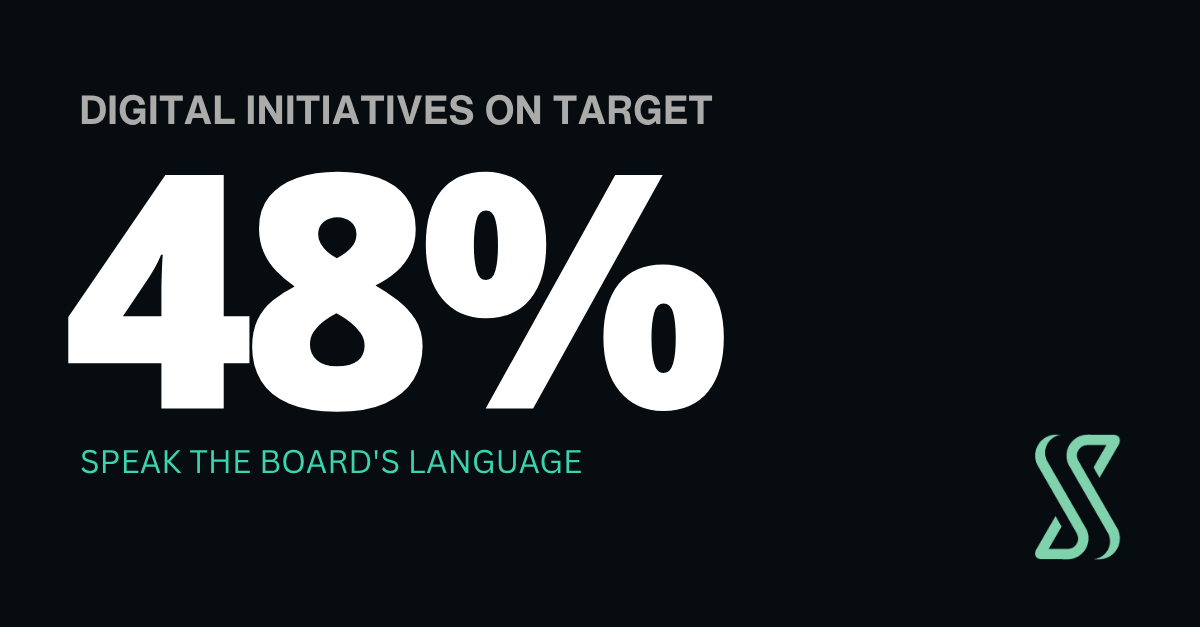

Only 48% of digital initiatives meet their business targets (Gartner, 2024). The gap often opens in the boardroom, long before the first system goes live.
Most technology leaders who struggle to communicate technology strategy to the board do not lack technical capability. The problem is translation: connecting technology to margin, risk and growth.
Reading time: 8 minutes | Keywords: communicate technology strategy to the board, strategic CIO, CIO business partner, IT strategy board presentation, technology leadership
| Key Takeaways |
Only 48% of digital initiatives meet or exceed their business outcome targets (Gartner, 2024).
|
A CIO walks into a board meeting with a forty-slide deck on cloud migration, network resilience and ERP consolidation. Twenty minutes in, the chair asks one question: what does this do to our margin? The room goes quiet. The strategy was sound, but the way it was presented lost the board.
This is the most common failure we see when technology leaders try to communicate technology strategy to the board for the first time. It is rarely a capability problem. It is a translation problem. Gartner's 2024 CIO and Technology Executive Survey found that only 48% of digital initiatives meet or exceed their business outcome targets. The organizations that beat that average are not the ones with the best architecture. They are the ones where technology and business leaders share the same language and the same targets.
For CIOs and IT directors in rental and construction companies, the stakes are concrete. Fleet utilization, project margin, equipment downtime, safety compliance and cash collection all depend on systems. The board knows that in principle. What it needs is to see it in the numbers it already uses to judge the business.
For most of its history, IT has been run and measured as a cost centre. Budgets are defended line by line. Success means uptime, tickets resolved and projects delivered on time. Those are real achievements, but they describe how well IT runs, not what IT changes in the business.
A strategic CIO is measured differently. The question moves from "how much does IT cost" to "what does the business gain, protect or accelerate because of this decision". The shift has measurable consequences. Gartner's Digital Vanguard, the small group of CIOs and business executives who co-own digital delivery, reports that 71% of its digital initiatives meet or exceed targets, against 48% overall (Gartner, 2024). In that group, business executives meet with their CIOs four times more often than their peers do.
Co-ownership starts with conversation, and the board is where that conversation carries the most weight. McKinsey describes the three core responsibilities of a board as hiring and firing the CEO, overseeing long-term strategy, and guiding culture and ethics (McKinsey, 2023). Infrastructure is not on that list. Business strategy is.
The classic mistake is presenting the technology instead of the decision. In practice it shows up in three ways:
The third point matters more than most technology leaders expect. Markides and MacLennan argue in Harvard Business Review (2024) that strategy only lands when leaders explain the alternatives they considered and why they rejected them. A board asked to approve a single option with nothing to compare it against will either approve it with no real commitment, or push back on details because it has no other way to test the reasoning.
There is also a time constraint. McKinsey notes that board service can require around 200 hours a year (McKinsey, 2023). That time covers audit, risk, remuneration, strategy and the CEO's agenda. Your technology roadmap competes with all of it.
"The board is not asking whether your architecture is sound. It is asking whether the business is safer, faster or more profitable because of it."
Boards think in three currencies: economic value, risk and growth. Every technology initiative you bring to the board should be expressed in at least one of them, with a number attached.
Then apply the criteria the board already uses for any capital decision: expected return, payback period, key assumptions, main risks, and the decision points where the board can stop or redirect the investment.
Context makes this more important, not less. Harvard Business Review's 2025 executive playbook on presenting strategy to the board notes that in a volatile environment, concern for short-term survival pushes boards toward risk mitigation and conservative thinking (HBR, 2025). A technology strategy framed only as opportunity will meet resistance. One framed as risk reduction with a clear economic case stands a better chance.
"The crane shows as available in the yard and as on contract in the system. That gap is not an IT issue. It is lost revenue nobody has put a number on."
Structure is half the work. Delivery is the other half. Harvard Business Publishing found that 77% of senior leaders rate communicating for impact as an important capability, and 73% want to develop it further (Harvard Business Publishing, 2025). The skill is widely recognized. It is rarely practised in technology roles, where credibility has traditionally come from technical depth.
Four habits make the difference in a first board presentation:
Clarity is harder than it looks. Research from MIT Sloan Management Review, cited in Harvard Business Review, found that only 28% of executives and managers responsible for strategy could list three of their company's strategic priorities (HBR, 2022). If the people who build strategy struggle to recall it, a board that sees your technology plan once a quarter will not reconstruct it from a dense deck.
Once the language is right, the structure follows. This is the sequence we work through with technology leaders preparing their first strategy discussion with a board:
The roadmap is where many presentations slip back into technical detail. A board does not need to know the order in which systems will be migrated. It needs to know when it will see the first measurable result, what that result will be and what it will cost to get there.
BCG Henderson Institute's 2026 research on the corporate strategy function makes a point about AI that applies well beyond it: AI transformation is a strategic choice, not just a technology choice (BCG, 2026). In our experience, the same holds for ERP, data platforms or field service systems. When technology leaders present these decisions as strategic choices with business consequences, boards treat them that way.
"A roadmap built on technical milestones asks the board for trust. A roadmap built on business milestones gives it a way to verify."
The first board presentation sets the pattern for every one that follows. Get it right and technology becomes a standing item in the strategy discussion. Get it wrong and IT goes back to the cost line, defended once a year at budget time.
This is the work Strolling Digital does alongside technology leaders. We do not write the strategy for them. We help them structure it around the governance, return and prioritization criteria a board expects, and we test it before it reaches the boardroom.
Is your next board presentation built around your systems or around your business results?
Prepare your first technology strategy for the board in a diagnostic session with Strolling Digital. Let's talk.
Start with the business problem and the decision you need, not the technology. Express each initiative in economic value, risk reduction or growth, with a number attached. Show the options you considered, a business case and a roadmap with decision gates tied to business milestones.
Boards want to understand how technology decisions protect margin, reduce operational and regulatory risk, or accelerate growth. Their core responsibilities are the CEO, long-term strategy, and culture and ethics, not infrastructure detail. A CIO who frames technology in those terms is treated as a strategic partner, not a cost centre manager.
By co-owning outcomes with business leaders instead of reporting IT activity. Gartner's 2024 research shows that CIOs and business executives who co-own digital delivery see 71% of their digital initiatives meet or exceed targets, compared with 48% overall.
Presenting the technology instead of the decision. That means leading with architecture, reporting activity instead of outcomes and offering a single option with no alternatives. Boards respond better when they can see the trade-offs and why one path was chosen over others.
Organize it around business milestones rather than technical phases. For each stage, show when the first measurable result will appear, what it will be and what it will cost. Include explicit decision gates where the board can review results before approving the next investment.
Gartner found in 2024 that only 48% of digital initiatives meet or exceed their business outcome targets. One recurring cause is a disconnect between technology and business leadership, where initiatives are defined and measured in technical terms rather than shared business outcomes.