Digital Transformation

Project failure isn't a methodology problem. It's a leadership and strategy problem.
Only 31% of projects successfully deliver their scope, schedule, and quality objectives. Despite decades of investment in methodologies, certifications, and management tools, the project failure rate hasn't materially improved.
Reading time: 7 minutes | Keywords: project failure, business acumen, project leadership, project success, strategic clarity
| Key Takeaways |
Only 31% of projects successfully deliver their defined scope, schedule, and quality objectives.
|
I want to start with something uncomfortable. Despite decades of innovation in project management methodology, despite massive investments in PMO infrastructure and training, despite adoption of Agile, SAFe, Six Sigma, and every framework under the sun, the fundamental project success rate hasn't materially improved. If anything, we're going backward.
The numbers are well known, but they're worth stating together so the real weight becomes visible (Standish Group, CHAOS Report).
In a world where project management has been professionalized, where tools give unprecedented visibility into execution, and where project managers stack up certifications, most projects still don't succeed on their original terms. Something is fundamentally broken in how we approach delivery.
The conventional explanation blames poor planning, inadequate resourcing, changing requirements, weak governance. These are real issues. But they're not the root cause. They're symptoms of something deeper, something we don't talk about honestly enough.
The data point that should change how we think about enterprise projects is this: project size is the single strongest predictor of success. Not methodology. Not tools. Not governance. Size (Standish Group, CHAOS Report).
This isn't because small projects are inherently easier. Many are genuinely complex. It happens because complexity grows exponentially, not linearly, as projects scale. Every additional stakeholder multiplies communication paths by a factor of ten. Every additional month on the timeline makes requirements that were clear in month one obsolete by month twelve. Every increase in budget attracts organizational politics and competing agendas.
The conventional response to this data is to try harder: more planning, more governance, more process. That's exactly the wrong direction. You can't manage exponential complexity with linear processes. At a certain scale, complexity itself becomes the problem. Additional process doesn't help. It makes things worse.
When you analyze what distinguishes large projects that meet their objectives from the ones that fail, the most relevant finding has nothing to do with methodology or process rigor. It comes down to a single question: does the project leader understand the business context they're operating in?
Business acumen in the context of project leadership is the combination of three concrete capabilities.
This isn't a technical project management skill. You can be brilliant at building timelines and managing scope and have zero business acumen. And you can lack formal PM training and still have business understanding deep enough to make you an extraordinarily effective leader.
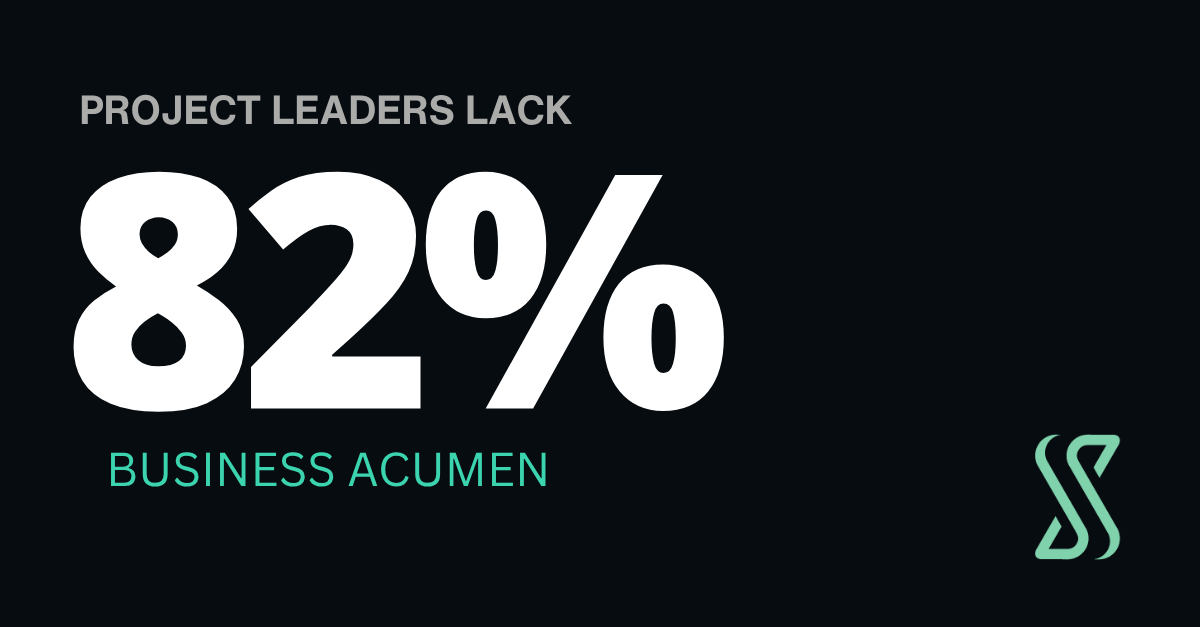
The number that describes where things stand today is telling: only 18% of project leaders demonstrate high business acumen, meaning they genuinely understand the business context they're operating in (Strolling Digital, primary internal source). Which means 82% of project leadership operates without the single factor that most impacts the final outcome.
"It's like hiring pilots who have passed all their certifications but have never actually understood aviation physics."
When you compare projects led by people with high business acumen to projects led by people without it, the differences are significant (Strolling Digital, primary internal source).
The difference is this sharp because when a leader understands the business context, they make fundamentally different decisions at every fork in the project.
If a project lacks strategic clarity from the start, if the organization hasn't precisely decided what success means and how this project fits into its broader priorities, no superior methodology and no rigorous execution will save it. The result is brilliant execution toward the wrong goal.
This is the most common pattern in organizations that invest in methodologies, tools, and governance and still keep failing: they launch projects with strategic ambiguity baked in from day one. The project can deliver exactly what was defined in the charter and still miss the real strategic objective. Or it gets cancelled halfway through because priorities shifted. Or it gets delivered but never adopted because the business context had changed by the time it landed.
"Organizations spend more time planning how to execute the wrong thing perfectly than they spend deciding what the right thing is. Better methodology doesn't fix that. Only clearer strategy does."
The first and most important lever for improving project success isn't in execution methodology. It's in the clarity of strategy and the quality of leadership before execution begins. Get those two things right, and execution becomes manageable. Get them wrong, and no amount of process rigor makes up for it.
If the main drivers of project failure are strategic ambiguity and business acumen gaps in leadership, the levers for improvement are different from what most organizations are prioritizing.
Improving project success isn't a technical problem. It's a leadership and strategy problem. It requires organizations to get more precise about strategy before execution, to select and develop leaders based on business acumen as much as PM skill, and to size their projects to what human organizations can actually execute well in practice.
None of this is new. But it's counterintuitive in an industry that has spent the last two decades optimizing execution methodology. The core insight is simple: execution methodology matters, but it comes second. Strategy and leadership come first.
The organizations that will improve their project success rates over the next few years aren't the ones investing in the latest frameworks and tools. They're the ones having honest conversations about strategic clarity, building business acumen into their project leadership, and making harder calls about scale and complexity. That's where the real competitive advantage sits.
Is your transformation project stalled or underperforming?
In most cases, the problem isn't execution. It's strategic clarity and the leadership profile driving it. At Strolling Digital, we work exactly at that breaking point. Let's talk.
The most frequent root cause isn't methodology or tools: it's strategic ambiguity from the start and a lack of business acumen in leadership. According to the Standish Group (CHAOS Report), only 31% of projects successfully deliver their defined scope, schedule, and quality objectives. The remaining 69% fail or fall short for reasons that start before execution even begins.
It's a project leader's ability to understand the strategic context they're operating in: the organization's priorities, stakeholder dynamics, and the market forces affecting the project. It isn't a technical PM skill. It's business understanding applied to decision-making during execution.
Because complexity grows exponentially, not linearly, as projects scale. More stakeholders multiply communication paths. Longer timelines make initial requirements obsolete. Bigger budgets attract organizational politics. Standish Group (CHAOS Report) data shows only 10% of large programs meet their original objectives, versus 90% of small projects.
No. Rigorous methodology can improve execution, but it can't resolve ambiguity about what's being executed or why. The most common outcome when strategic clarity is missing is beautifully managed failure: the project delivers on its defined scope but misses the real strategic objective, or it's delivered but never adopted because the business context changed.
The questions that matter go beyond certifications: do they understand this business? Can they articulate how this project connects to the organization's strategy? Do they understand the real interests of key stakeholders? Do they know the market forces shaping the project? A PMP certification credentials execution skill. Business acumen credentials leadership capability.
By keeping scope tight and timelines short, complexity stays manageable: fewer stakeholders, fewer communication paths, less chance that initial requirements go stale before delivery. Delivering value through four six-month initiatives is dramatically more likely to succeed than one 24-month program with the same total budget.
Get precise clarity on what success means, how it aligns with current strategy, and what tradeoffs are acceptable. This has to happen before assigning a leader, choosing a methodology, or approving budget. Strategic clarity from the start doesn't guarantee success, but its absence almost always guarantees failure.